The basics
The stick vs unitized curtain wall choice is a logistics decision before it is an engineering one.
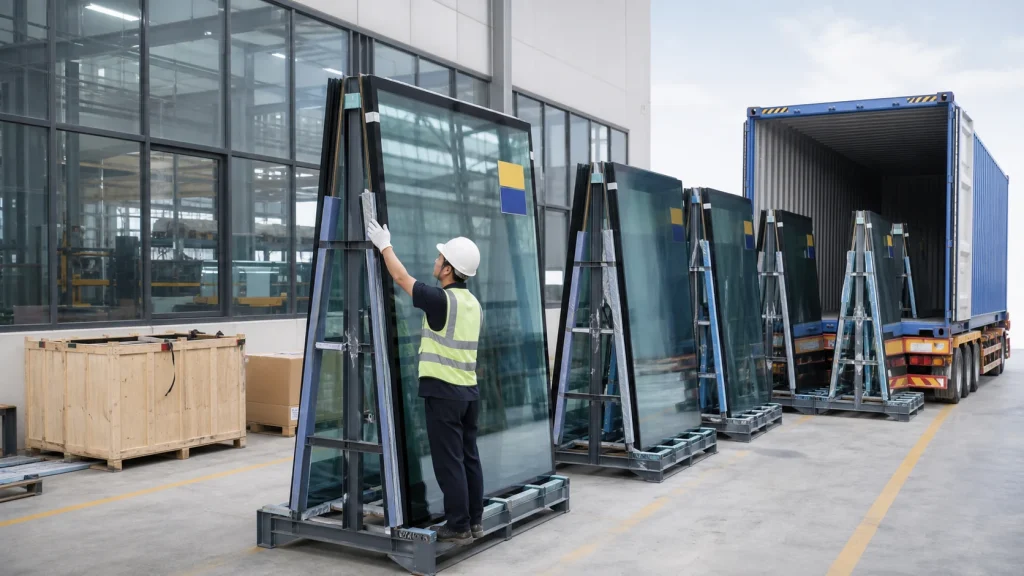
Stick curtain wall arrives as aluminium lengths, glass and brackets, assembled on site piece by piece. Unitized curtain wall arrives as factory-glazed panels lifted into place floor by floor. The choice turns on repetition, programme, site access and weather exposure. Height on its own tells you very little.
Decision data
The stick vs unitized curtain wall decision matrix
| Decision factor | Stick curtain wall | Unitized curtain wall | Project question |
|---|---|---|---|
| Geometry | Highly adaptable to one-off grids and interfaces | Strongest with repeated panel modules | How much of the elevation truly repeats? |
| Site programme | More work and sealing occur on site | Factory-glazed panels accelerate enclosure | What is one week of delay worth? |
| Logistics | Ships efficiently as profiles, glass and accessories | Requires panel racks, lifting and sequenced deliveries | Can trucks move directly to the crane? |
| Quality control | Depends heavily on site workmanship and weather | Moves more glazing and sealing into the factory | Where can critical joints be controlled best? |
Swipe horizontally to compare all four columns on mobile.
What each system actually is
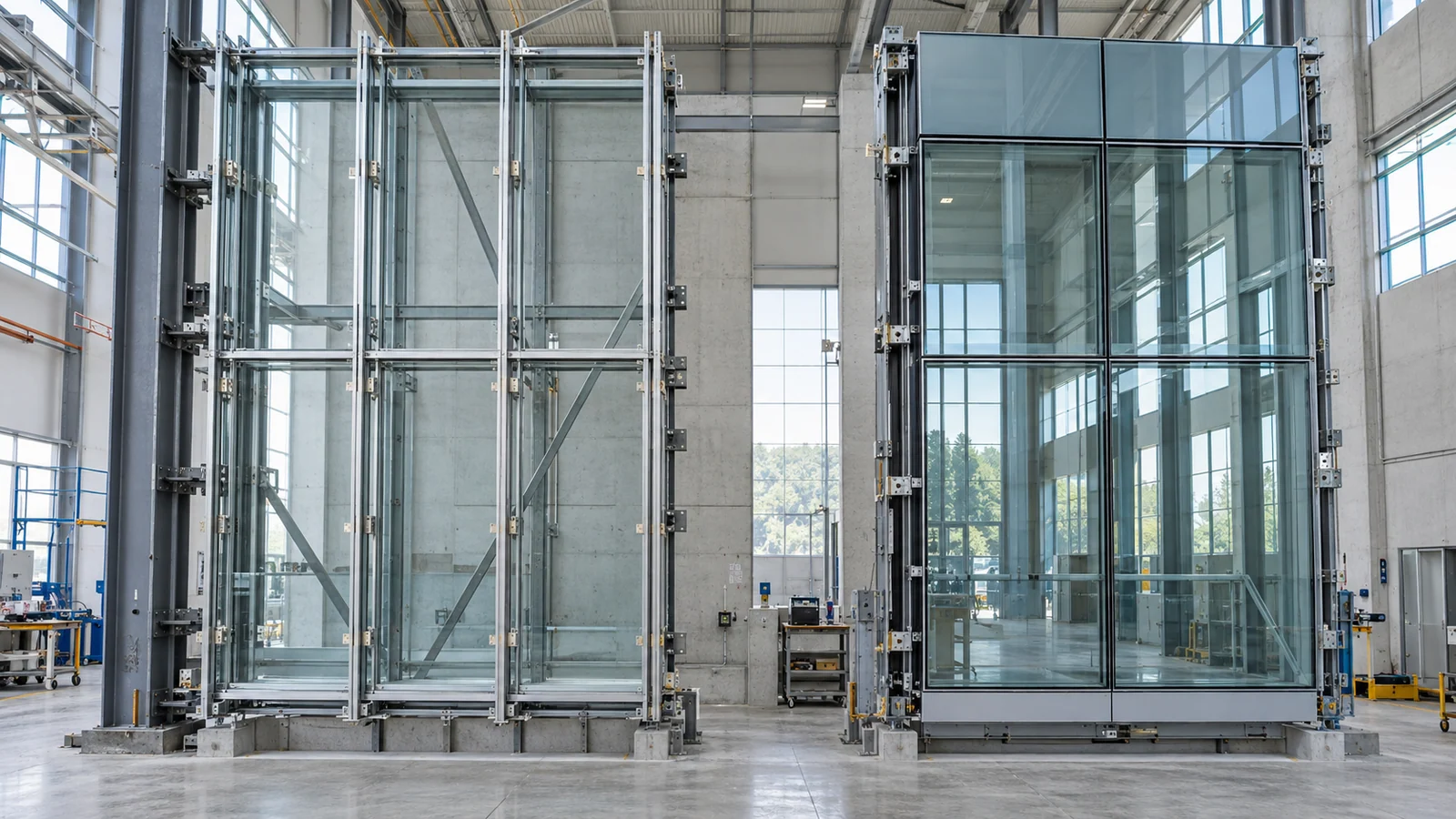
A stick curtain wall arrives as aluminium lengths, glass, brackets and gaskets, then is assembled on the building. It is an established and highly adaptable method and can be economical for one-off envelopes when site labour, access and weather exposure are properly allowed for.
A unitized system arrives as factory-glazed panels that are installed bracket by bracket. It is established for major multi-storey and high-rise programmes and can also suit repeated residential or public-building elevations when panel size, lifting strategy and logistics are engineered around the project.That factory-versus-site split is the essence of the stick vs unitized curtain wall comparison.
The real trade-offs
Stick often carries a lower factory-package cost for comparable one-off geometry, but requires more assembly and sealing on site. Unitized places more work in the factory and can accelerate enclosure, but it also adds panel engineering, handling and logistics. The stick vs unitized curtain wall comparison has to include installation and programme, not just the supply price.
Site logistics matter as much as the numbers. A constrained urban site with limited storage may favour a sequenced unitized delivery, while a site with workable access, suitable labour and a less compressed programme may favour stick.
When stick wins
Stick earns its place on one-off envelopes, irregular geometry, smaller quantities, renovation interfaces and programmes where controlled site assembly is practical. What decides the question is module repetition, access, tolerances, labour capability and weather exposure, not how tall the building happens to be — that single correction resolves half of all stick vs unitized curtain wall debates.
When unitized wins
Short weather windows — in cold climates, unitized can be the difference between closing the building before winter or not. Repeating panel grids, which make fabrication efficient. Sites with zero storage. Programmes where every week of crane hire costs more than the cassette premium.
The strongest unitized cases are buildings where repeated panels and a floor-by-floor enclosure sequence genuinely shorten the programme.These are the cases where the stick vs unitized curtain wall decision effectively makes itself.
Our default recommendation
In most stick vs unitized curtain wall reviews, one-off geometry and flexible site assembly point to stick . For repeated multi-storey grids, towers and compressed enclosure programmes, unitized deserves a close look first. Bring the drawings, the programme and the site constraints, and let the system follow the project rather than the other way round.
Project decision note
Run the comparison as a whole-project decision
Start with the elevation rather than a preferred product. Map repetition, panel size, floor-to-floor height, slab-edge geometry, corners, entrances and zones that cannot follow a typical module. A unitized option gains value when many panels repeat and can move through one controlled factory and lifting sequence. A stick option gains value when geometry changes frequently, quantities are modest or local adjustment is more important than a rapid floor-by-floor enclosure rhythm.
Then model the site sequence. Record where materials can be stored, how panels or glass reach each elevation, when the crane or hoist is available, which floors must become weather-tight first and how the installer will manage tolerances. Compare temporary works, access, sealant operations, inspection points and likely weather disruption. The factory package is only one line in this calculation; programme and site resources can change the conclusion.
The decision should end with documented evidence, not a marketing preference. Ask each option to show the proposed module, anchors, movement strategy, drainage path, typical interfaces, testing basis, packing method and installation responsibilities. Price both options against the same performance criteria and boundary. If the building changes materially during design, revisit the comparison: a system selected for an early repetitive grid may no longer be the best route after setbacks, mixed cladding and special floors are introduced.

Foshan Tianyue Mixed-Use Tower
A flagship 40-storey mixed-use development in the heart of Foshan's Qiandeng Lake CBD, combining high-end retail, serviced apartments and a hotel in a single tower. The facade had to perform to demanding energy targets — a whole-building U-value of 2.0 W/(m²·K) for the curtain wall and 1.6 W/(m²·K) for the hotel's premium zones — while presenting a calm, blue-tinted glazed face to the city.
Open project recordPhotos are enough to begin
Start with the minimum useful brief.
For a project-specific answer, send the information available now. We will identify the missing inputs instead of asking you to complete the design before the first conversation. If drawings are unavailable, clear photos and rough dimensions are enough to begin.
- Plans, elevations and typical facade sections
- Floor-to-floor heights, spans and structural edge information
- Facade area, repetition and non-standard geometry
- Target enclosure date, storage and crane constraints
- Intended installer and their curtain-wall experience
Decision summary
The essentials
- Model the installation sequence before freezing the system.
- Compare total programme cost, not panel price alone.
- Test the proposed build-up and interfaces.
- Keep the local installer’s capability in the decision.
The winner of any stick vs unitized curtain wall comparison is the one that makes the building easier to engineer, fabricate, transport, install and maintain as one coordinated process. If a recommendation ignores the site programme or installer, it is incomplete.
Standards and references
Standards and references
Confirm the governing edition and project applicability with the appointed consultant and authority.
Rank Math FAQ block
Frequently asked questions
Does the stick vs unitized curtain wall decision depend on building height alone?
No. It can suit public, commercial and residential buildings where repeated modules and a compressed enclosure programme justify factory-glazed panels. It is also widely used on towers because repetition and floor-by-floor installation are naturally aligned.
Is stick curtain wall always cheaper?
Its material and factory cost is often lower, but site labour, access, weather protection and programme can reverse the total comparison. The right calculation includes installation and delay exposure, not only the supply rate.
Can one building use both systems?
Yes. Hybrid strategies are common when a repeated tower benefits from unitized panels while podiums, entrances or complex feature zones are better resolved with stick or structural glazing. Interfaces between systems must be designed explicitly.Mixed elevations are one of the most practical outcomes of the stick vs unitized curtain wall comparison.
What information is needed for a recommendation?
Provide elevations, typical details, floor-to-floor heights, structural movements, facade area, programme, site access, lifting assumptions and the intended installation team. These inputs reveal whether panelisation creates real value.
How much does a unitized curtain wall system cost compared to stick?
As a factory package alone, unitized usually carries a 15–25% premium driven by panel engineering, jigging and handling. Total project cost can reverse that: faster enclosure means earlier weather-tightness, shorter crane hire and earlier interior trades. The comparison only works at whole-project level.
Which curtain wall system types suit renovation projects best?
Stick, in most cases — renovation interfaces rarely follow a repeating module, floor-to-floor heights vary, and existing structure tolerances favour field-assembled adjustment. Unitized earns its place on renovation only where the existing grid is genuinely repetitive.
About the author