Facade acoustic performance: four rungs, each buying decibels
| Rung | Build-up | Typical gain | Venue role |
|---|---|---|---|
| Monolithic | Single toughened pane | Baseline only | Circulation, service zones |
| Insulating unit | Two panes, sealed air or argon cavity | +3 to +5 dB over single | Foyers away from direct traffic |
| Laminated insulating | Laminated pane plus cavity, damping interlayer | Further step, frequency-dependent | Road-facing halls and hotel rooms |
| Widened cavity + triple seal | Deeper cavity, asymmetric panes, three gasket lines | Highest practical grades | Silent rooms facing the noise source |
RELATED READING
Where the quiet rooms sit relative to the street is the first decision, and it belongs to venue zoning as covered in our theatre and venue facade hub.
Zoning beats hardware
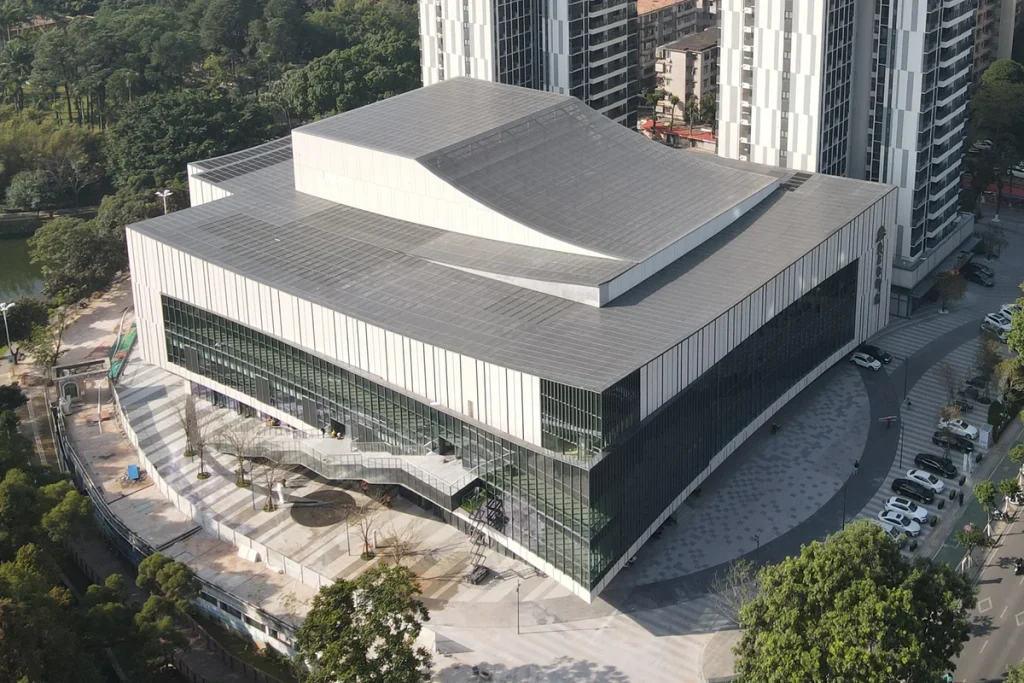
The cheapest move in facade acoustic performance is drawing the quiet rooms away from the road face. At the Maoming City Theatre, the 4,600 m² envelope coordinated stick curtain wall and stone-clad solid zones as one composition. Transparency concentrated where people arrive, enclosure where the programme demands darkness and quiet. The five cinema halls and the 1,200-seat auditorium simply never argued with the traffic. When zoning cannot fully solve it, and on tight urban sites it often cannot, the ladder takes over.
The build-up ladder, rung by rung
A single pane stops almost nothing worth counting. An insulating unit adds the mass-and-spring of a sealed cavity. A laminated pane adds a damping interlayer that works hardest in the mid frequencies where road noise lives.
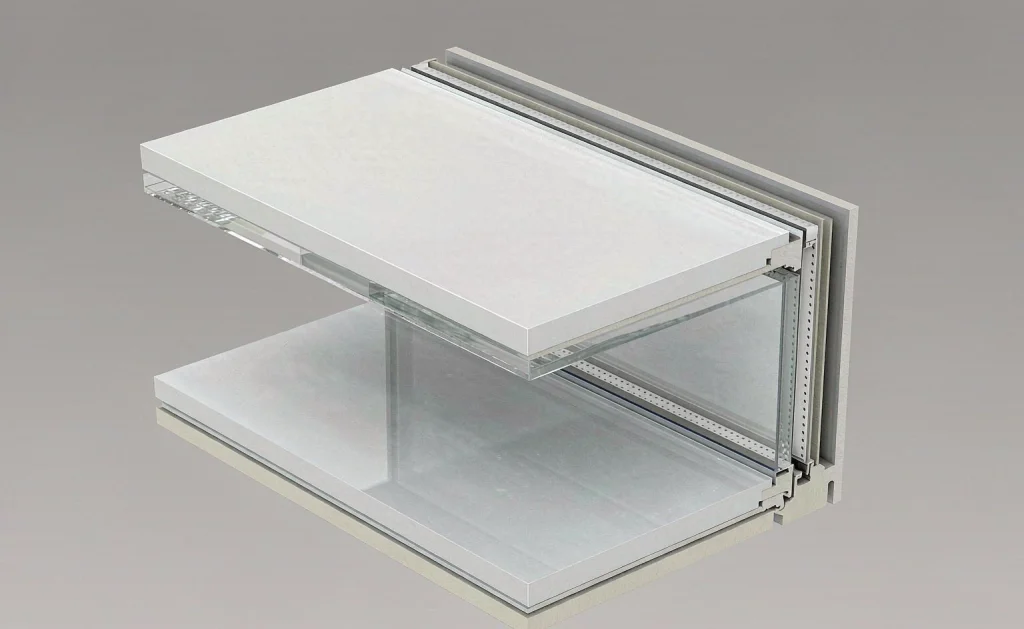
A wider, asymmetric cavity with dissimilar pane thicknesses avoids the coincidence dips where a build-up suddenly underperforms.
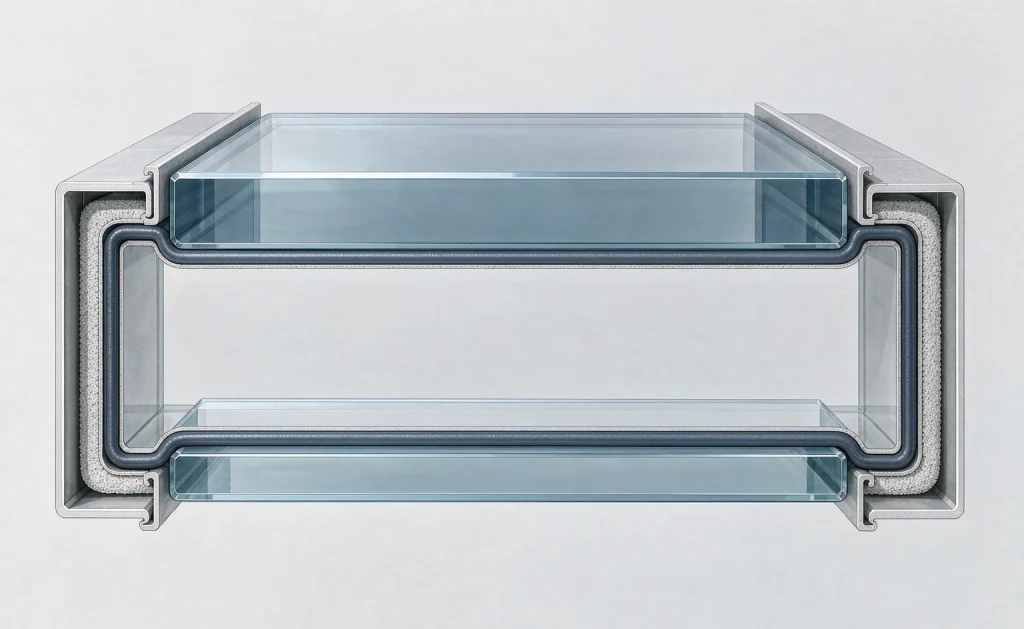
Each rung is a real, measurable purchase, and a supplier who cannot state which rung a room is on is not pricing facade acoustic performance at all.
Seals decide the delivery
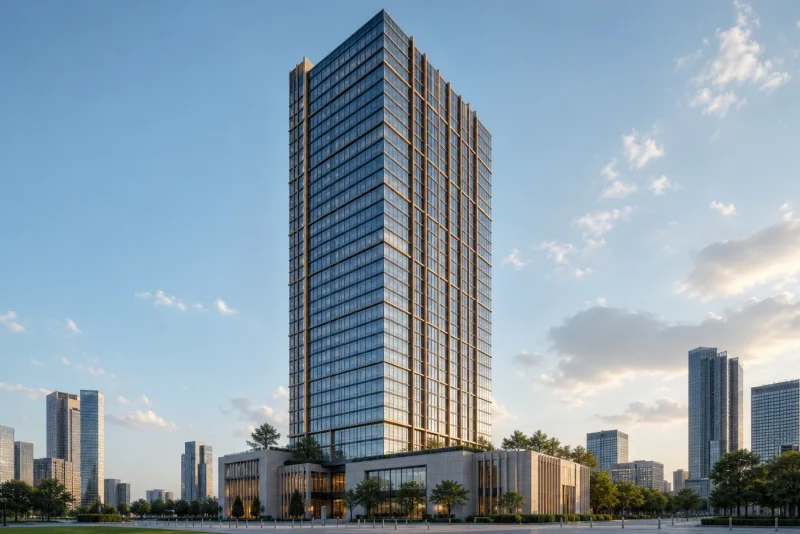
In delivered facade acoustic performance, a tested assembly performs only as well as its fitted state. On the Foshan Tianyue Mixed-Use Tower, a 40-storey, 18,000 m² envelope fronting a major CBD road delivered by Starveil Facade, the road-facing elevations combined the double-glazed Low-E build-up with a three-seal EPDM gasket system on the unit perimeter and a wider 12 A cavity. That is how the envelope reached a delivered facade acoustic performance of Rw 35 to 40 dB for apartments and Rw 40 to 45 dB for hotel rooms, verified against design calculation while still carrying the whole-building U-value targets. The same physics reads on venues: every operable door, every ventilation louver and every junction is a potential short circuit, and the gasket schedule deserves the same attention as the glass schedule.
Public buildings raise the stakes
A venue puts thousands of people behind the envelope every evening, and the acoustic brief arrives with safety and thermal demands attached. A study on record for the Basrah performing arts centre specified double-silver low-E laminated glass on warm-edge spacers under salt-humid, 50 °C conditions, one build-up answering heat, salt and sound at once. Thermal demands and facade acoustic performance trade against each other in the same cavity. The reconciliation logic in our existing thermal performance guide applies directly: the cavity width that helps sound also changes the U-value, so both numbers must be engineered together.
Verify, then hand over the numbers
Facade acoustic performance is a claim until it is a measurement. Laboratory ratings set the ceiling; site measurements set the truth, and the gap names the installation quality. Crowd-facing glazing carries its own safety logic, covered in our large-format glass safety guide, and the acoustic evidence belongs on the same handover file as the structural and thermal calculations. Asking for that file is one of the checks in our 24-question supplier checklist.
Send the noise, ask for the ladder
Send the site plan with the road, the room schedule with its quiet rooms marked, and any measured or assumed noise spectrum. Ask back for the rung each room sits on, the gasket and junction schedule, and the verification plan, laboratory ratings plus site measurement to ISO 16283. Starveil Facade grades facade acoustic performance room by room from the Foshan engineering desk, because a single blended Rw for a whole building tells nobody anything.
ما يجب تذكّره
- Zoning quiet rooms away from the road is the cheapest decibel.
- Each ladder rung buys a measurable step, not a marketing word.
- Wider, asymmetric cavities serve sound and change the U-value together.
- Three-seal perimeters decide whether tested ratings survive installation.
- Site measurement to ISO 16283 is the truth behind any facade acoustic performance claim.
RELATED READING
Explore our Facade Systems Hub to compare curtain wall systems and understand how glass configurations fit different building requirements. For a closer look at performance specification, read أولويات مواصفات الواجهات للمباني في دول مجلس التعاون الخليجي, which explains how glass, gaskets, sealants and project conditions should be coordinated. Our guide to العزل المائي للجدران الستائرية: لماذا تُعدّ استراتيجية تصريف المياه حاسمة examines sealing continuity, perimeter interfaces and the detailing needed to maintain envelope performance. You can also read الشهادات المهمة: CE / ASTM / الاعتمادات المحلية to understand how test reports and project-specific evidence support facade performance claims.
الأسئلة الشائعة
What Rw rating does facade acoustic performance need beside a main road?
It follows the road’s noise spectrum and the room’s quiet target. Delivered envelopes have graded roughly Rw 35 to 40 dB for apartments and Rw 40 to 45 dB for hotel rooms against a CBD road. Performance spaces typically need the higher end or dedicated zoning, because auditorium quiet targets sit well below residential ones.
Does triple glazing help with road noise?
Not automatically. A third pane adds mass, but acoustic gains come mainly from laminated panes with damping interlayers, asymmetric pane thicknesses and wider cavities. A well-designed laminated double unit can outperform a symmetric triple build-up on road noise, and it costs less thermally than it sounds.
Why does measured facade acoustic performance differ from laboratory values?
Installation quality. Gasket compression, junction detailing and any operable element can short-circuit a tested assembly. Site measurement to ISO 16283 quantifies the gap, which is why the verification plan belongs in the facade contract, not in the marketing file.
How do acoustics and thermal performance interact in one glazing?
AThey share the cavity. A wider cavity improves sound reduction and changes the U-value, low-E coatings serve heat while doing little for sound, and laminated interlayers serve sound while slightly affecting thermal behaviour. Both numbers must be engineered together, as they were on the delivered tower envelope cited above.
Will ventilation openings undo the acoustic design?
They can, if they are treated as an afterthought. Every operable vent and louver is a short circuit in the envelope, so acoustic-rated vents, staggered airflow paths or mechanical ventilation with silencers belong in the early design. The louver and gasket schedule deserves the same attention as the glass schedule.
What is flanking transmission, and how do facades control it?
It is noise that bypasses the glass through junctions, solid walls or the building structure. Even a top-rung glazed build-up underperforms if the wall it meets is lightweight or the junction is unsealed. Mass continuity and sealed detailing at every material change are what keep the site-measured rating close to the laboratory one.
عن الكاتب