باختصار
A manufacturer owns the machines and employs the people who turn aluminium billets into finished panels. A trading company owns neither; it coordinates between factories and buyers, and charges for that coordination. Neither is a fraud. But a quotation that reads like a factory’s while coming from an office gives you factory-level risk with office-level control, and that gap is where facade projects lose weeks. The trading company vs manufacturer test exists to expose that gap before signature.
The five-line test
| Quotation line | Manufacturer’s version | Middleman’s version |
|---|---|---|
| Material specification | Named alloy and temper with a standard reference: 6063-T6 to GB/T 5237 | “High-grade aluminium”, “as per sample” |
| Tooling and dies | Die costs listed, with ownership terms for after the project | Absent, or “included” with no ownership terms |
| Machining tolerances | References a published standard, EN 12020-2 or GB/T 5237, and states internal limits | “Industry standard tolerances” |
| Inspection rights | Production-stage inspection at the factory, with named gates | Dispatch inspection only, at a warehouse |
| Substitution | Changes require written approval and re-approved drawings | “Equivalent materials at supplier’s discretion” |
Any quotation can be compared on price. Reading a facade quotation line by line, these five lines settle the trading company vs manufacturer question and tell you what the price is standing on.
Why facades feel the difference more than catalogue products
A facade package is an engineered product, not a catalogue item. Custom dies, project-specific glass build-ups, a fabrication QA regime: every order leaves the standard price list the moment drawings are approved. When production hits a problem, a drifted die or a glass batch that fails a test, the person who can fix it stands next to the machine. A manufacturer walks to the floor. A trading company phones a factory that may be running five other customers that week, then phones you back. That difference in response time does not appear in the unit price, which is why the unit price is the wrong place to start a trading company vs manufacturer comparison.
What moves a facade number most is covered in our 2026 facade cost guide; this article is about what the number stands on.
The trading company vs manufacturer test, line by line
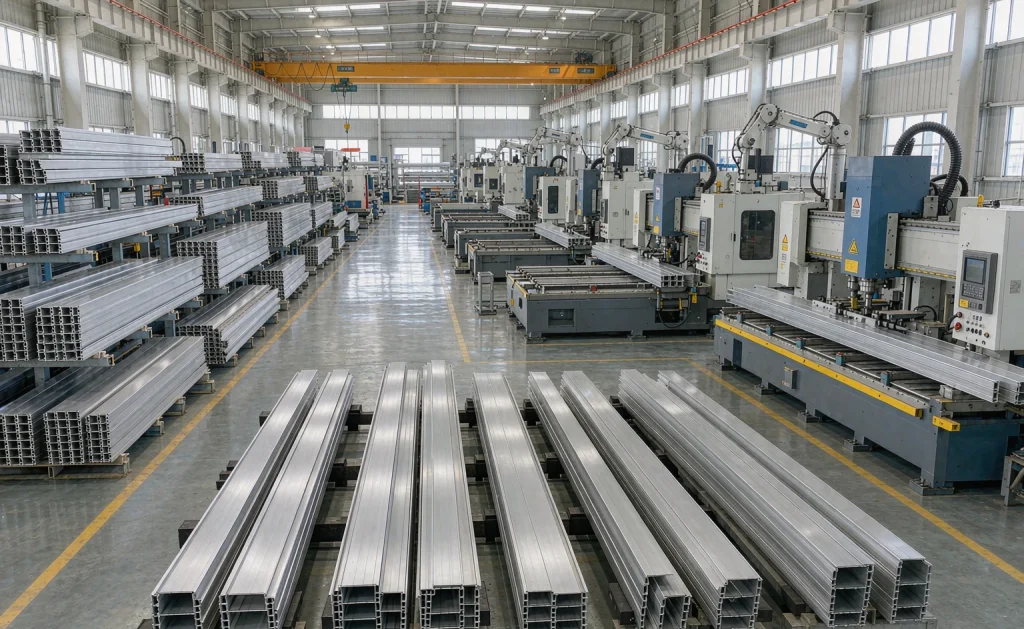
Line one, the material specification. A factory names the alloy and temper because its billets arrive with composition certificates and its press is set for them. Our own lines run one 1,800 t press and two 1,000 t presses, extruding 6063 and 6061 alloys, so the alloy on the quotation is the alloy the plant actually runs. “High-grade aluminium” means the writer does not know, or is not saying, which mill the metal comes from.
Line two, tooling. Custom profiles need custom dies. In Foshan, extrusion dies are typically cut by long-term partner die makers, so the signal to look for is specificity rather than ownership claims: die costs listed, the cutting partner named on request, and ownership terms for after the project closes. Die ownership, drawings and revision control should be written into the contract. A missing tooling line means the dies belong to someone you have never been introduced to.
Line three, tolerances. “Industry standard” is not a standard. A factory quotes EN or GB machining tolerances because its QA checks against them. Our own quotations state the internal limits we hold on machined profiles, tighter than the published standard, and the inspection records that prove it.
Line four, inspection rights. The clause that matters reads “production-stage inspection at the factory”. Inspection at dispatch, or at a warehouse, inspects the result of a process you were never allowed to see.
Line five, substitution. “Equivalent materials at supplier’s discretion” transfers material risk to you, silently. A manufacturer writes that changes require written approval, because a change on its floor costs it re-work, and it wants no ambiguity either.
Those five lines carry real programmes. The 1,400 m² Baghdad Commercial Facade record is a stick curtain wall on a three-storey commercial building in central Baghdad, specified for 50 °C summer heat, dust and brief winter storms, and delivered ex-works in 22 weeks. Its specification lines read exactly the way this trading company vs manufacturer test teaches you to read them: PVDF coating for dust abrasion, warm-edge spacers for condensation control, pressure-equalised drainage. When several of these lines raise doubts at once, our guide on facade quotation red flags lists what to walk away from.
What trading companies legitimately add
This is not a case against middlemen. For catalogue products, standard windows, doors, generic hardware, a good trading company earns its margin: it consolidates three factories into one shipment, one payment and one English-speaking contact, and it takes order volumes no single factory wants. If your project is standard product, buy the coordination.
An engineered facade is different. The coordination a trading company sells, drawings, dies, glass, packing, milestone inspection, is exactly the coordination an engineering-led manufacturer runs in-house. There you pay for coordination once, to the party that owns the machines. The question is not which model is better; the trading company vs manufacturer question is which product you are actually buying.
One email that settles it
How to tell if a supplier is a factory without visiting it: three questions in writing settle the trading company vs manufacturer question before any price negotiation: first, the business licence, with the factory address on it; second, who machines the dies and who owns them after the project; third, whether production-stage inspection at the factory is written into the contract. A manufacturer answers all three in an afternoon, usually with attachments. A middleman answers with a brochure, a condition, or silence. Checking that an ISO 9001 certificate’s scope actually covers the plant on that licence is covered in which certifications matter for an imported facade.
The on-site version of the trading company vs manufacturer test, walking the floor in process order, is covered in How to Audit a Curtain Wall Factory in Foshan, China. The deeper questions behind these three are collected in 5 أسئلة يجب طرحها قبل استيراد نظام واجهات.
The Foshan wrinkle: when a factory is partly an assembler
Foshan’s cluster blurs the trading company vs manufacturer line further. Some suppliers own a hall but assemble other mills’ extruded profiles. Others extrude but subcontract glazing or finishing. None of that is disqualifying; in a cluster where die shops and anodising lines sit minutes apart, subcontracting is often the rational choice.
What matters is that the quotation says so. Ask for a process map: extrusion, machining, finishing, glazing, packing, each marked in-house or subcontracted, with the subcontractor named where it carries your tolerance risk. A supplier who marks that map without being asked twice is telling you how they manage the cluster. Starveil Facade quotations state engineering scope, fabrication QA regime and packing terms line by line; expect the same disclosure from anyone you buy from.
Send us the quotation you are holding
Send it to Starveil Facade, anonymised if you prefer, and we will mark the lines where the trading company vs manufacturer difference shows:
- Drawings or elevations, if they exist, or photos of the building
- The destination country and port, so packing and freight terms can be planned early
- Your consultant’s required test standards
The full sequence from approved drawings to a loaded container is mapped in our facade delivery timeline guide, so you can see which decision locks at which week. The term you trade on decides who carries cost, risk and customs duty at each handover, compared in our guide on facade incoterms.
ما يجب تذكّره
- Read material, tooling, tolerance, inspection and substitution lines before comparing prices
- A factory writes from its own process; a middleman writes from what it has been told
- Trading companies earn margin on catalogue products, not engineered packages
- In Foshan, ask for the process map: in-house or subcontracted, line by line
- Three written questions settle the trading company vs manufacturer question in one email
The cheapest quotation is the one whose five lines you can verify.
RELATED READING
Compare supplier claims with our curtain wall and facade systems guide. Before committing to a supplier, review How to Audit a Curtain Wall Factory in Foshan, China: A Buyer’s Checklist و استيراد الواجهات: 5 أسئلة ذكية قبل البدء. For a broader view of project pricing, read كم تكلّف الواجهة؟ دليل الأسعار لعام 2026
Questions buyers ask
In a trading company vs manufacturer comparison, is a trading company always more expensive than a factory?
Not always, and that is the trap. On unit price a middleman can match or undercut a factory, because the comparison you are shown rarely includes tooling, inspection gates and the change-order terms that decide the final account. Compare the five lines first, then the price.
Can a trading company handle facade engineering?
Some employ engineers and do it well. The test is accountability: who stamps the shop drawings, who carries professional liability for them, and who physically corrects a die when a profile drifts. If those three answers point to three different companies, you have found the gap.
My supplier extrudes profiles but buys glass. Is that a problem?
No; most facade suppliers buy glass, because float lines and coating lines are a different industry. The question is disclosure. A quotation that names the glass maker and its coatings is safer than one that says “equivalent glass supplied”.
How do I check die ownership before signing?
Ask who cuts the dies, where they are held during production, and what happens to them at project close. In Foshan most extruders, including us, work with long-term partner die makers, so a clear answer names the partner and the storage arrangement in one sentence. Anything vaguer is a negotiation about someone else’s property.
Does the trading company vs manufacturer gap close if the middleman names the factory?
Yes, and the answer is diagnostic. A transparent middleman names the plant that will run your profiles and arranges a direct introduction or a live video walk with it. A refusal, or a factory that changes after the deposit, tells you the quotation was never grounded in a specific production line.
What payment schedule suits a first order with a factory I have not visited?
Tie payments to evidence gates, not calendar dates: drawings approval, production-stage inspection, and pre-shipment inspection with photographs of the loaded containers. A supplier confident in its process accepts milestone terms readily, because each gate is evidence it already produces.
عن الكاتب