In this guide
- What counts as large format glass
- Hazard and code decision matrix
- Safety and post-breakage behaviour
- Glass and frame sizing
- Logistics and replacement
- Cost-driver table
- Responsibility boundary
- What to send and what to remember
What counts as large format glass
Public buildings use large panes to make entrance halls, concourses and circulation spaces feel continuous. A 3 by 5 metre pane at a theatre foyer reads very differently from the same pane at the top of a tower. The crowd is close, the reflection is visible and the consequences of breakage are higher. The format decision therefore starts with the human relationship to the pane, not with a millimetre dimension. Where large format glass meets a crowd, that relationship decides the budget before any engineering input does. Once that relationship is mapped, the engineering team can decide where the extra cost of lamination, heat treatment and specialised handling is justified. For the same pane high on a tower, the load logic is covered in our high-rise curtain wall decisions guide.
Hazard and code decision matrix
The table below names possible glass families, not prescriptions. Final selection must follow the applicable local code, the project engineer’s review and the post-breakage requirement.
EN 12600 classifies the impact behaviour and breakage mode of flat glass under a pendulum test. ASTM E1300, published at astm.org, is used to assess glass resistance to specified uniform lateral loads within its scope. Neither standard alone determines where safety glazing is required. That decision follows the applicable local code, occupancy, support condition and post-breakage requirement. In practice, safety glazing crowd areas provisions are what turn a large pane into a laminated build-up: the closer the public gets, the more the code asks of the interlayer.
Laminated glass is one form of safety glazing, and its value for large format glass in crowd areas is that the interlayer can hold fragments in place after breakage, preserving the barrier and reducing the risk of falling glass. Toughened monolithic glass is also a safety glass in the sense that it breaks into small, relatively blunt fragments. It may be acceptable in some locations under local codes such as 16 CFR Part 1201 or ANSI Z97.1, but it does not provide retention after breakage. We list the classification behind each zone of the elevation so that the specifier can see the code path, not just the thickness.
Glass and frame sizing
With large format glass, build-up, aspect ratio, boundary support and framing stiffness must be reviewed together. A deeper mullion may reduce frame movement, but it does not by itself resolve glass stress, centre deflection or post-breakage performance. The visible reflection on a public facade is unforgiving, so the design team should model the deformed shape under load before fabrication rather than discover it after handover.
Large panes also concentrate thermal stress at the edges, which makes heat treatment and edge quality part of the specification. Holes, notches and patch fittings need finished edges that match the supplier’s process limits. On some elevations, structural glazing can reduce visible framing, but it still requires the same glass-and-support review.
Logistics and replacement

Large format glass beyond standard sheet dimensions dictates its own supply chain. It is fabricated to project specification, handled on suction equipment and A-frame racks, packed in purpose-made stillages, and installed with a lift plan. Replacement is the same operation repeated years later. The panel-by-panel manual delivered with the envelope records each pane’s dimensions, build-up and fixing route, and it turns a future breakage from a site investigation into a scheduled reorder.
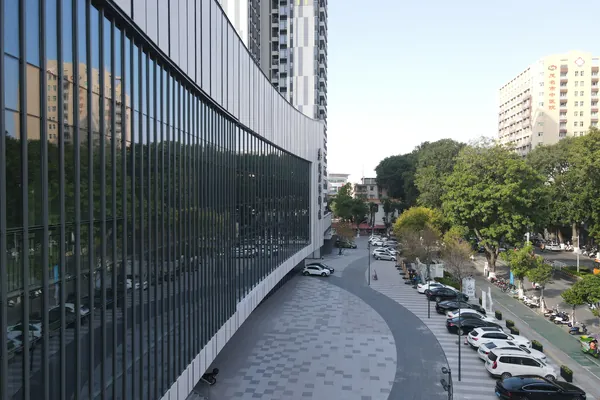
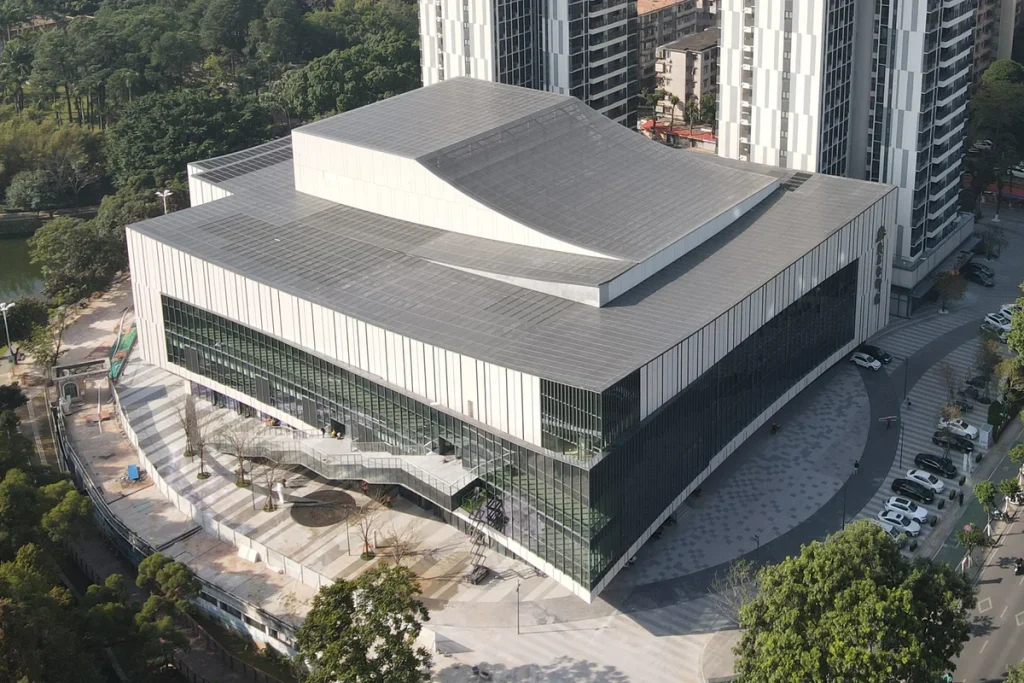
The delivered Maoming City Theatre shows the pattern at civic scale: a 4,600 m² theatre and cinema complex with a 1,200-seat auditorium and five cinema halls, its stick curtain wall and stone-clad solid zones coordinated as one composition and delivered by Starveil Facade as a single design-supply-installation contract in 26 weeks ex-works. The manual already sits with the maintenance team, so every later replacement of large format glass on that facade has a single reference. See our delivery timeline guide for how these logistics sit inside the wider programme.
Cost-driver table
The title promises cost guidance. Because reliable unit prices for large format glass depend on region, currency and specification, the table below lists cost drivers and the evidence needed to control them, not invented dollar rates. That is the working answer to any jumbo glass curtain wall cost question asked before zoning: the drivers decide the number, not the other way round.
| Cost driver | Why it changes cost | Early design lever | Evidence required |
| Pane dimensions | Yield, processing and transport | Adjust module and grid | Elevation and glass schedule |
| Lamination / heat treatment | Processing, testing and breakage risk | Zone by hazard area | Local code and risk location map |
| Coatings / low-iron glass | Raw-sheet and processing limits | Define visual and thermal targets | Optical and thermal parameters |
| Edgework / holes / notches | Processing complexity and breakage rate | Optimise supports and nodes | Detail drawings |
| Transport / lifting | A-frame, container and crane requirements | Check maximum transport size early | Route and lifting plan |
| Future replacement | Maintenance and downtime cost | Design a replaceable path | Panel register |
Responsibility boundary
This article explains the decision path. It does not prescribe a transferable glass build-up. Final selection must be confirmed against the applicable local code, design loads, pane dimensions, support conditions, post-breakage requirement and appointed local consultant review.
This is also true for the Botswana record above. The 6 mm monolithic glass used there is a record of one delivered project-specific selection, not a transferable specification. Pane dimensions, support, wind criteria, breakage consequence and the applicable local code must be reassessed for every project.
Send the crowd plan
Send the Starveil Facade team the foyer and concourse plans with the audience flow marked on them, the architectural elevations, and the local glazing code reference. The proposal returns with the envelope zoned by crowd relationship, a build-up per zone of large format glass with the classification named, and the cost consequences of each sight-line decision made explicit. Our supplier checklist widens the question set beyond glazing before any contract is signed.
Key takeaways
- Zone the large format glass by crowd relationship and local code before pricing any of it.
- Classification, EN 12600 for impact behaviour and ASTM E1300 for uniform lateral load resistance, is the specification. Thickness is its consequence.
- Deflection over wide spans is a glass-and-support-system decision.
- The panel-by-panel manual delivered with the envelope is worth as much as the glass.
- A delivered project record is not a transferable specification. Every project needs its own engineering review.
References
- EN 12600: Glass in building – Pendulum test – Impact test method and classification for flat glass.
- ASTM E1300: Standard Practice for Determining Load Resistance of Glass in Buildings.
- 16 CFR Part 1201: Safety Standard for Architectural Glazing Materials (US CPSC).
- ANSI Z97.1: Safety Glazing Materials Used in Buildings – Safety Performance Specifications and Methods of Test.
RELATED READING
For further insights into facade design and project execution, explore our guides to the stick curtain wall system and structural glazing system, which explain different approaches to facade construction and architectural appearance. You can also review our facade delivery timeline guide to understand the coordination involved from drawings to delivery. For practical project references, see the Maoming City Theatre project and Botswana Sports Arena project, which demonstrate how facade systems are applied in different building environments.
Frequently asked questions
Is large format glass safe in crowd areas of public buildings?
Large format glass in crowd areas needs safety glazing that meets the applicable local code and impact classification, often laminated where retention of fragments or fall protection matters. EN 12600 classifies impact behaviour. ASTM E1300 sizes against uniform lateral loads. The local code and project engineer decide where each type is required.
How large can a single glass pane be on a curtain wall?
Jumbo mill sheets allow panes of roughly 3.3 by 6 metres. Beyond that, project-specific fabrication applies. Practical limits include deflection, framing stiffness, glass stress, handling logistics and replacement access.
Is monolithic glass acceptable on public buildings?
Monolithic glass may be feasible in selected non-hazardous locations, but distance from public contact is only one input. Pane size, support, heat treatment, thermal stress, fallout consequence, maintenance access and local code must all be reviewed. The Botswana arena record is one project-specific example, not a general specification.
How are oversized glass panes replaced years later?
Through the panel-by-panel manual delivered with the envelope, which records each pane’s dimensions, build-up and fixing route.
Does a larger pane always need thicker glass?
No. Thickness follows load sizing under ASTM E1300 and the applicable local code, together with support conditions, aspect ratio and thermal stress. Two panes of the same size can require different build-ups on different elevations of the same building.
How much does large format glass cost compared with standard panes?
There is no reliable square-metre rule. Cost for large format glass moves with pane yield, heat treatment, lamination, edgework, transport and the planned replacement path, as the cost-driver table above shows. An elevation-based quotation from a supplier beats any generic rate.
About the author