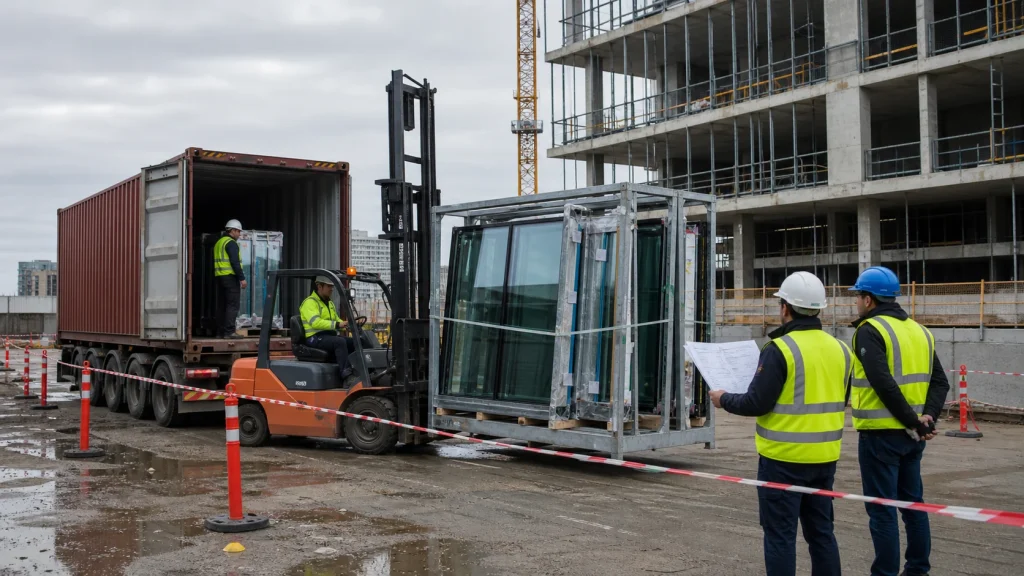
Four layers carry the thermal load
| Layer | Typical construction | Thermal job | Failure mode if wrong |
|---|---|---|---|
| Frame | Aluminium with a 24 to 34 mm polyamide thermal break | Stops the metal bridging inside to outside | Cold stripes and condensation on the frame |
| Glazing | Double or triple IGU, Low-E coating, argon fill | Cuts radiative and conductive loss through the vision area | Centre-of-glass U-value climbs 30% or more |
| Spacer | Warm-edge stainless or composite, not bare aluminium | Keeps the edge-of-glass zone warm | Condensation ring around the glass perimeter |
| Perimeter | EPDM gaskets plus sealed, drained cavities | Stops air washing heat around the unit | Draughts, dust ingress, acoustic leaks |
A thermal break curtain wall system only performs when all four layers are specified together. The insulated curtain wall quotes worth comparing are the ones that state a whole-wall U-value with the build-up written next to it.
Centre of glass is not the wall
The number most suppliers lead with is the centre-of-glass U-value, because it is the best number they have. The insulated curtain wall u value that should matter to a buyer is the whole-wall figure: glass, frame, edge zone and spandrel combined. On the delivered Foshan Tianyue tower, 18,000 m² of unitized envelope across 40 storeys, centre-of-glass reached 1.4 W/(m²·K) with double-silver and triple-silver Low-E units, while the verified whole-building value was 2.0 W/(m²·K) for the curtain wall and 1.6 W/(m²·K) in the hotel premium zones. That gap of roughly 0.6 W/(m²·K) is the frame talking, and it is why two quotes with identical glass can be a full energy grade apart.
The thermal break: small strip, big consequence
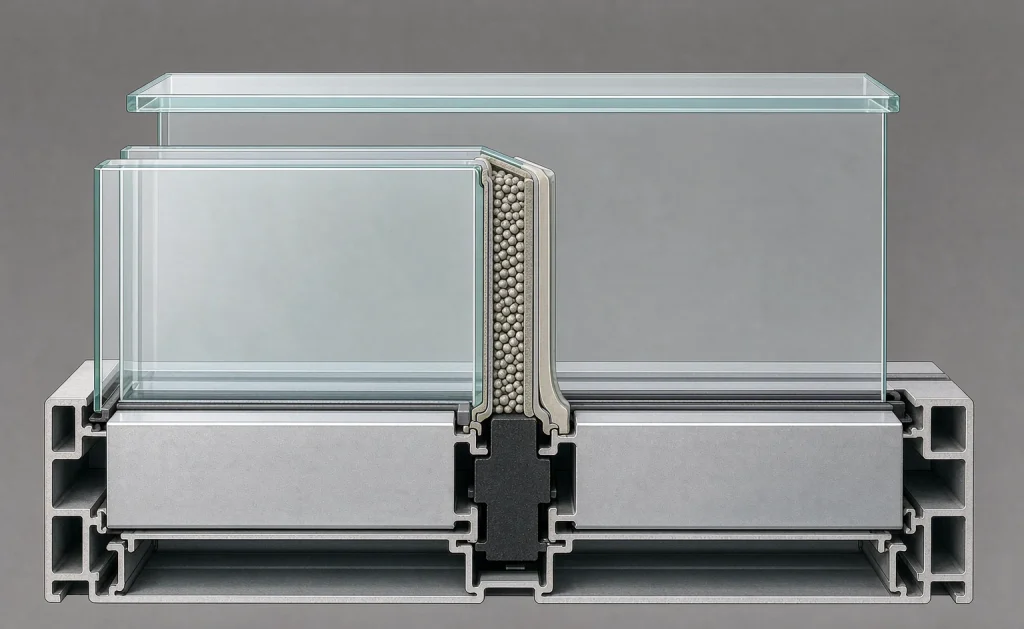
Aluminium conducts heat roughly a thousand times faster than still air, so an unbroken frame is a radiator fin bolted to the building. A polyamide strip of 24 to 34 mm, rolled and crimped between the inner and outer profiles, cuts that bridge and lifts the frame from a liability to a line item.

Depth matters: a deeper break with a wider cavity performs measurably better in cold climates, and the crimping quality decides whether the composite section also keeps its shear strength. Every insulated curtain wall we engineer starts with the frame section, because no glazing upgrade can rescue a frame that leaks heat around it.
Warm-edge spacers and the edge-of-glass zone
The coldest part of a conventional IGU is its perimeter, where an aluminium spacer bar conducts heat straight out of the cavity. Warm-edge spacers in stainless steel or composite drop that conductivity sharply and raise edge-of-glass temperatures by several degrees, which is the difference between a clear pane and a condensation ring on a cold morning. The Maple Court study in Calgary, a 1,420 m² five-storey rental building, specified thermally broken frames with triple glazing on the north elevation for exactly this physics. On any insulated curtain wall, the spacer line in the IGU data sheet deserves the same scrutiny as the coating.
Condensation: map the risk before winter does
Curtain wall condensation prevention starts on the drawing, not with a dehumidifier. Picture the risk map on a January morning: interior humidity finds its dew point first at the glass edge near the spacer, then along the bottom frame member where warm room air stratifies low, then at any spandrel where insulation runs thin or a bracket bridges the cavity.
The Maple Court study ran a condensation-risk analysis for each typical unit type, and the local authority review passed it without comment. That analysis, a temperature-profile calculation per unit type, is what buyers should request with any insulated curtain wall quotation in a heating climate, because repainting stained reveals costs more than the calculation ever will.
Climate decides the build-up
In Calgary the enemy is a minus 30 °C night; in the Gulf it is a 50 °C afternoon driving solar gain through the same glass. Cooling climates trade some U-value ambition for a lower SHGC and external shading logic, while heating climates spend the budget on triple glazing, deeper thermal breaks and condensation analysis. Our GCC thermal performance guide covers the hot-climate arithmetic, and the climate-responsive facade study for the Gulf shows how mashrabiya shading pairs with BIPV glazing on solar elevations. An insulated curtain wall is always a local answer to a specific sky.
What verified performance looks like
Verified means calculated, tested and traceable. The Tianyue whole-wall values were checked against calculation before handover, every unit is numbered to its material certificates, and outgoing inspection measures 100% of key dimensions on every profile with AQL batch sampling under GB/T 2828.1. Production discipline is what turns a calculated insulated curtain wall into a delivered one, and our notes on unitized panel production rates show what that discipline looks like per day. For the wider frame, the high performance curtain wall hub places the U-value beside the four other numbers that complete a serious brief.
Send the climate, get the build-up
Send the Starveil Facade engineering team the project location and climate zone, the elevations with their orientations, the local energy code or U-value target, and any condensation history if this is a replacement. Ask back for the whole-wall U-value calculation, the frame section with its thermal break depth, the IGU data sheet and the spacer specification for your insulated curtain wall. The answer tells you whether you are talking to a fabricator or to a guessing shop.
What to carry forward
- Whole-wall U-value is the number to buy; centre-of-glass is the number to be sold.
- Thermal break depth and spacer type are line items, not details.
- Cold climates buy triple glazing and condensation analysis; hot climates buy SHGC and shading.
- An insulated curtain wall quote without the build-up stated is not comparable to anything.
- Ask for the condensation-risk analysis per unit type in any heating climate.
Explore More Facade Manufacturing Guides
Choosing an insulated curtain wall requires more than comparing glass specifications; the complete facade system, local climate and project performance requirements must work together. Explore our facade systems to understand the available curtain wall configurations, structural options and performance considerations. For more detailed guidance, read our guide to thermal performance for facades in hot-desert climates to understand how solar gain, thermal breaks and condensation risks affect facade design, review facade specification priorities for GCC buildings for climate-specific material and performance requirements, or explore curtain wall design-supply for North American projects to learn how thermal continuity, condensation control and local engineering requirements shape a complete curtain wall package.
Frequently asked questions
What U-value should an insulated curtain wall achieve?
Demanding briefs target whole-wall values of 1.4 to 2.0 W/(m²·K). On the delivered Foshan Tianyue tower the verified figure was 2.0 W/(m²·K) for the curtain wall and 1.6 W/(m²·K) in the hotel premium zones, against centre-of-glass values of 1.4 W/(m²·K) with double-silver and triple-silver Low-E units.
Is triple glazing always worth it in an insulated curtain wall?
In heating climates with long winters, usually yes on exposed elevations. In cooling climates the budget often works harder in a lower SHGC coating and shading. The Maple Court study in Calgary put triple glazing on the north elevation only, which is the right kind of selectivity.
What is a thermal break made of?
Glass-reinforced polyamide, typically a 24 to 34 mm strip crimped between the inner and outer aluminium profiles. The crimping quality matters as much as the material, because a loose shear connection weakens the frame under wind load.
How is whole-wall U-value calculated?
Area-weighted from the vision, spandrel and frame zones under NFRC 100 or EN ISO 10077 methods. Ask for the calculation summary with the zone areas, not just the headline number.
Can condensation appear on the outside of the glass?
Yes, on high-performance units under clear-night sky conditions, because the outer pane runs colder. It is harmless, clears with the morning, and usually reads as a sign the IGU is doing its job.
What documents prove the thermal performance before shipment?
The IGU data sheet with coating and gas fill, the frame U-value calculation, the condensation-risk analysis for cold climates, and batch material certificates. Together they form the thermal evidence file for the order.
About the author