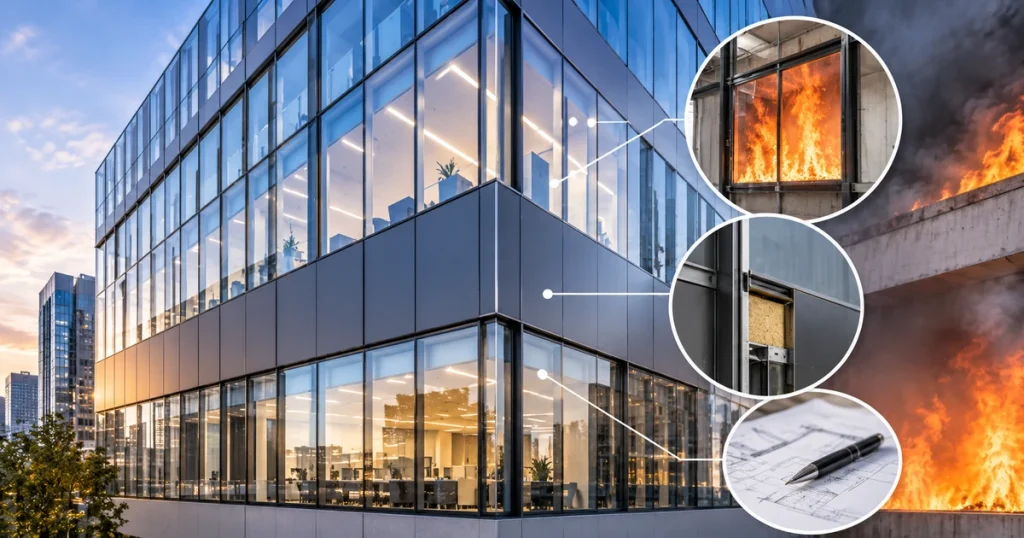
Fire compliance is a code path, not a product badge
Fire compliance on a facade is decided by the code path, not by a product badge. A fire rated curtain wall is an assembly whose glass, frame, fixings and spandrel are tested and classified together to resist fire for a stated period, and the rating never belongs to the glass alone. Buyers should first fix the path, EN 13501 in Europe or ASTM E119 in the ASTM tradition, then demand the classification report that matches the exact build-up being quoted. The sections below map that path and show how to write it into an RFQ so it can be enforced at handover.
A fire rated curtain wall is an external wall assembly with a verified fire resistance classification, expressed as integrity and insulation ratings such as EI 30 or EI 60 under EN 13501-2, or as an hourly endurance under ASTM E119 at astm.org. One clarification saves buyers money: NFPA 701, sometimes searched as nfpa 701 curtain wall, is a flame test for textiles and films such as drapery, and it does not certify facade assemblies. The document that matters is the classification or test report naming the exact glazing, frame and fixing combination.
Pick the path before you price the glass
| Path | Jurisdiction flavour | Classification language | What the buyer receives |
|---|---|---|---|
| EN 13501-2 | Europe and EN-aligned markets | E, EW or EI with minutes: EI 30, EI 60, EI 90 | Classification report for the tested assembly |
| ASTM E119 | US and ASTM-aligned markets | Hourly fire endurance rating | Test report on the full assembly |
| Local civil defence | Gulf and other approval regimes | References EN or ASTM plus local annexes | Approval letter tied to the project submission |
Every fire rated curtain wall assembly is rated as tested, which means the glass, frame, gaskets, fixings and spandrel build-up in the report must match what ships. A substitution of any layer voids the rating.
The code path decides everything downstream
The first RFQ question is not which glass but which jurisdiction. A project submitted under EN rules needs classification reports; a project under IBC-flavoured codes leans on ASTM E119 hourly ratings and, where combustible components are involved, NFPA 285 assembly tests. The fire strategy document from the local consultant should name the path, the required rating per zone and the acceptance evidence. A fire rated curtain wall quoted before that document exists is a guess with a price attached, and guesses get re-priced at the worst moment in the programme. Buyers who have seen a fire strategy arrive late know the pattern: the glazing package is re-specified, the spandrel detail is redrawn, and the mock-up budget doubles because the first assembly tested was the wrong one.
Spandrel fire stopping: the floor edge is the weak point
Most facade fire spread does not go through the glass. It goes around the slab edge, through the gap between the floor and the back of the spandrel.
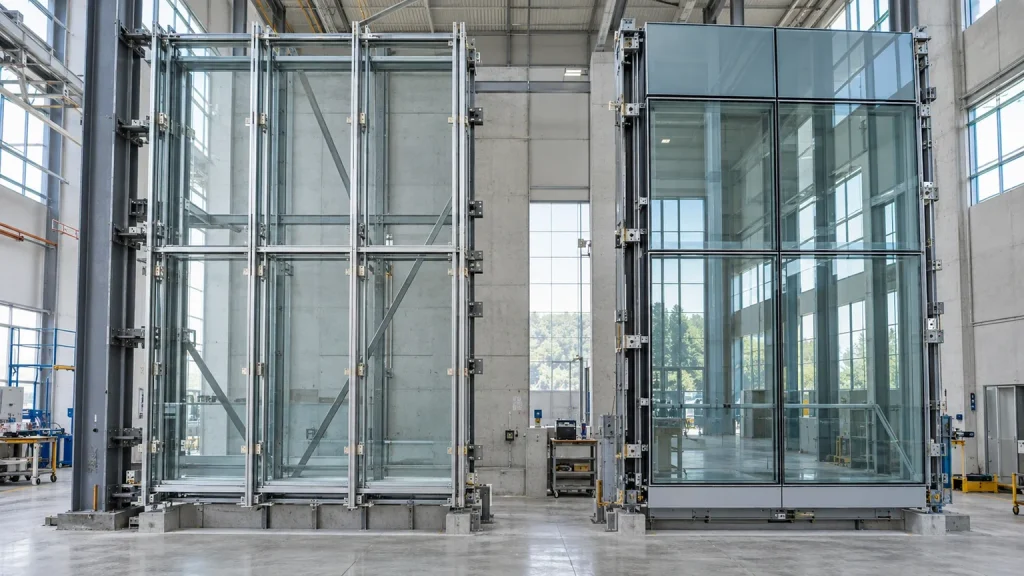
Curtain wall fire stopping details close that gap with mineral wool compressed into the void and a smoke seal at the room side, detailed per floor and per movement joint. The RFQ should ask for the spandrel build-up drawing with the fire stopping product named, its rating stated and its fixing shown. On any fire rated curtain wall, this one detail outranks every aesthetic line on the elevation, because it is the detail the fire inspector will photograph first.
Fire rated glazing must match its frame
Fire rated glazing for facades comes in families: wired glass, tempered ceramics, and intumescent-laminated units that add insulation performance.
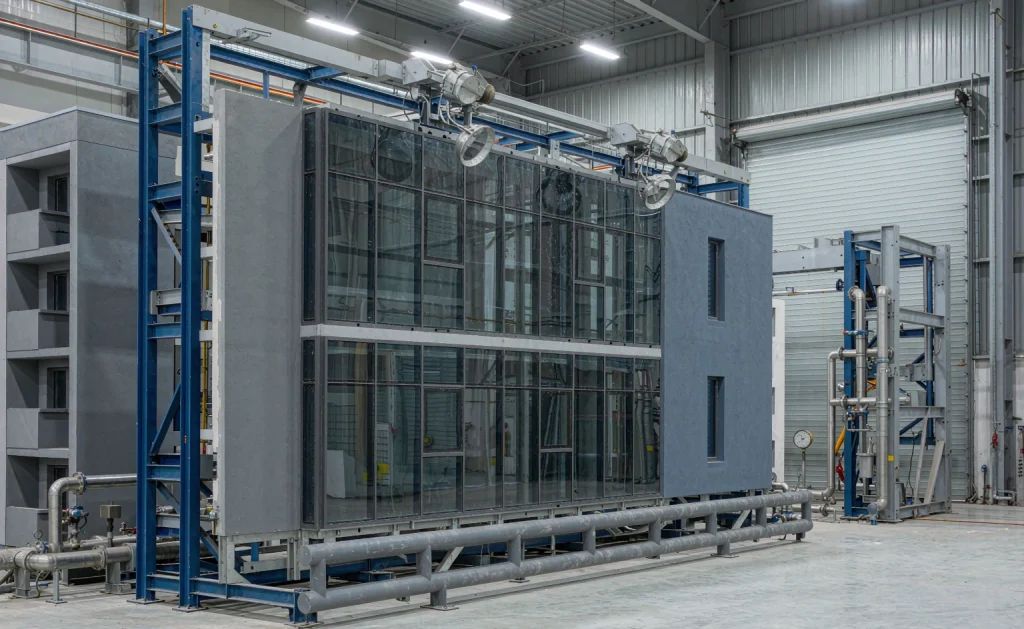
Each family behaves differently in a frame, and each is tested as a specific assembly with a maximum pane size, a defined gasket and a stated fixing. Buyers should check three numbers on the classification report: the rating in minutes, the maximum tested dimension, and the exact frame series named. A larger pane than the tested size, or a different frame, and the rating is paperwork about somebody else’s wall. A fire rated curtain wall is only ever the assembly that was tested.
Assembly logic on a real venue
A reference study on record for a Riyadh performing arts venue, a public envelope combining a civic foyer, theatre volumes and a fly tower, shows how the zones divide: each volume carries its own fire compartment boundary, and smoke-control coordination was written into the early facade brief alongside wind, thermal and acoustic criteria. Delivered evidence sits at Botswana Sports Arena, a 5,200 m² envelope seating around 8,000 in 28 weeks ex-works, where the technical documentation for a crowded public building was handed to the appointed local reviewer at completion. In venues of this kind the fire file is reviewed as hard as the structure, and a fire rated curtain wall assembly that cannot show its report slows the whole approval. Fire also never sits alone in the review: the same envelope is judged on energy, acoustics, structure and weather in one cycle, and our high performance curtain wall hub maps the five-indicator table that fire joins as a sixth line on public buildings.
Writing fire requirements into the RFQ
State the code path and the rating per zone. Require the classification or test report number, the tested assembly description and the maximum pane dimensions. Name the spandrel fire stopping product and its rating. Require that any substitution triggers re-verification rather than a letter of comfort. And set the mock-up expectation early, because our guide to facade mock-up testing shows how assemblies get proven before production cuts metal. A fire rated curtain wall RFQ written this way filters out suppliers who sell glass and hope the paperwork catches up.
What the evidence file looks like
The fire section of a handover file contains the classification or E119 reports, the spandrel fire stopping data sheets with ratings, installation photographs of the floor-edge closure before it was concealed, and the approval correspondence with the local reviewer. Our overview of facade design for theatres, arenas and exhibition halls covers how this file sits beside acoustic and access evidence in venue work, and the guide to certifications that matter separates load-bearing documents from decorative ones. Without that file, a fire rated curtain wall is a claim; with it, the rating survives the building’s first insurance audit.
Send the fire strategy, not the wish list
Send the local consultant’s fire strategy or code summary, the zone plan showing compartment boundaries, and the elevation drawings. Ask back for the proposed classification reports, the tested assembly descriptions and the spandrel fire stopping detail for each zone of your fire rated curtain wall. Starveil Facade engineers that submission package from the Foshan desk before pricing, because the code path decides the product.
What to carry forward
- The rating belongs to the tested assembly, never to the glass alone.
- Fix the code path first: EN 13501 or ASTM E119, plus the local annex.
- The slab-edge fire stopping detail outranks every aesthetic line.
- Substitutions void ratings; re-verification is cheaper than re-litigation.
- A fire rated curtain wall is bought on documents and installed to photographs.
Frequently asked questions
What rating should a fire rated curtain wall have?
It follows the local fire strategy: EI 30 or EI 60 is common at compartment boundaries and escape routes, while the spandrel zone typically needs fire stopping rated to the floor slab period. The consultant’s fire strategy document is the source, not the supplier’s catalogue.
Is fire rated glass enough for a fire rated curtain wall?
No, the rating belongs to the tested assembly of glass, frame, gaskets and fixings. On the delivered Botswana Sports Arena, a 5,200 m² envelope for around 8,000 spectators completed in 28 weeks ex-works, the documentation package handed to the local reviewer covered the complete envelope, which is how public buildings actually pass.
Does NFPA 701 apply to curtain walls?
No. NFPA 701 is a flame propagation test for textiles and films such as curtains and drapery. Facade assemblies follow EN 13501 or ASTM E119, and combustible cladding assemblies may additionally face NFPA 285.
What is spandrel fire stopping?
Mineral wool and smoke seals compressed into the gap between the floor slab edge and the back of the spandrel panel, closing the route fire would otherwise take between floors.
Can a standard curtain wall be upgraded to a fire rating later?
Almost never economically. The rating lives in the frame, gaskets and fixings as much as in the glass, so the assembly must be designed, tested and bought as a unit.
How do we verify a supplier’s fire documents?
Check that the report names the exact frame series, glass build-up and maximum pane size being quoted, and that the issuing laboratory is accredited. On large orders, cross-reference the report number with the laboratory directly.
Explore More Curtain Wall Engineering and Compliance Guides
Fire compliance is only one part of specifying a reliable curtain wall system. To understand how fire performance fits into broader facade requirements, explore our high-performance curtain wall guide, which covers thermal, structural, air and water performance alongside compliance documentation. For more detailed guidance, read our article on facade mock-up testing to understand how complete assemblies are verified before production, review facade certifications and local approvals to identify the documents required for different markets, and explore facade design for theatres, arenas and exhibition halls to see how fire safety, acoustic performance and other technical requirements are coordinated in complex public buildings.
About the author