The basics
Facade compliance evidence has four layers: material documents, assembly performance test reports, project-specific engineering and local authority approval. A certificate matters only when its tested build-up, dimensions and pressure range match the proposed project configuration.
Decision data
The facade certifications hierarchy
| Evidence layer | What it supports | What it cannot prove alone | Typical owner |
|---|---|---|---|
| Material documents | Glass, aluminium, coating, sealant and hardware properties | Performance of the complete installed facade | Supplier and manufacturer |
| Assembly test report | Air, water, wind or other tested mock-up performance | Every untested size, interface or project pressure | System supplier or testing party |
| Project engineering | Loads, spans, anchors, glass and interfaces for the project | Local statutory acceptance without required review | Facade engineer and local consultant |
| Authority approval | Acceptance under the destination process | Manufacturing quality after approval | Client-appointed local team and authority |
Swipe horizontally to compare all four columns on mobile.
The three families of evidence
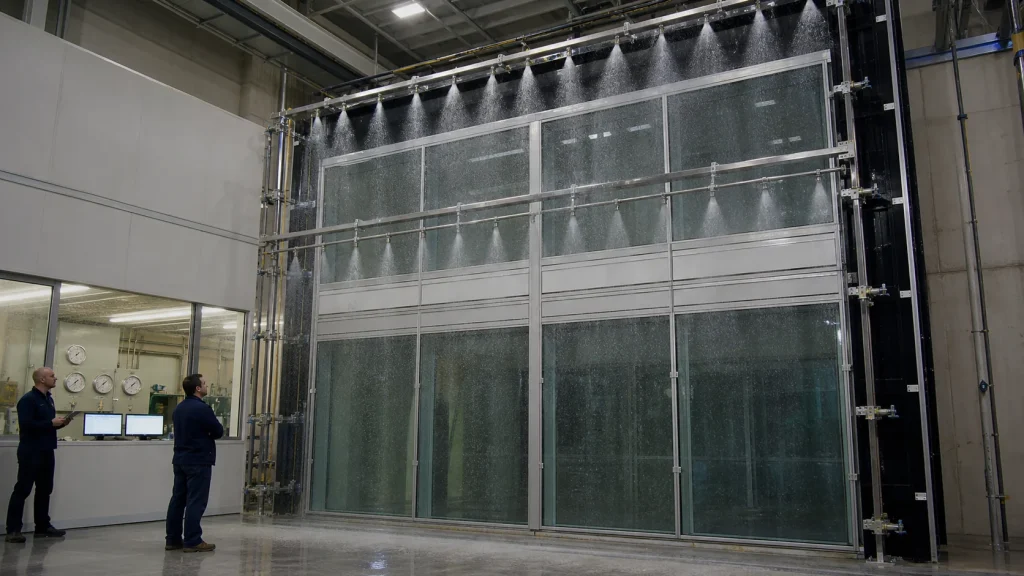
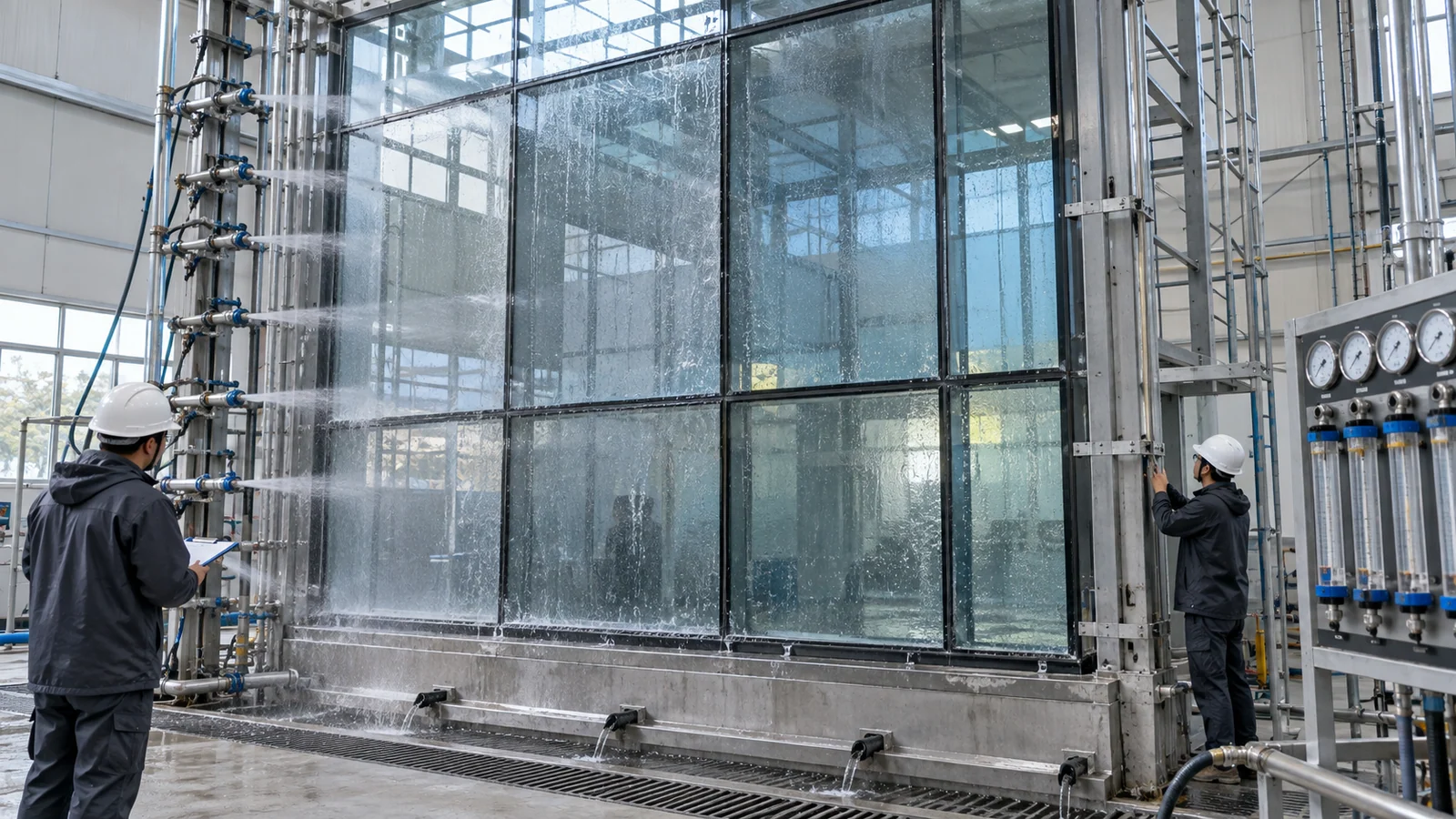
European practice commonly references EN 13830 for curtain walling together with its supporting assessment and test methods. North American specifications may reference ASTM E283/E283M for air leakage, ASTM E331 for static water penetration, ASTM E330/E330M for structural performance and FGIA/AAMA methods such as AAMA 501.1 for dynamic-water testing or AAMA 501.2 for diagnostic field checks. Australasian specifications may reference AS 2047 and AS/NZS 4284. The governing edition, specimen and acceptance criteria must come from the project specification and appointed consultants.
Test reports vs. certificates
A test report records how a defined specimen performed under stated conditions. Test reports are the raw evidence layer beneath most facade certifications.Under the applicable European product-standard route, CE marking is supported by a Declaration of Performance and the required assessment and verification of constancy of performance, including factory-production-control obligations where applicable; it is not a universal project approval. Ask what was tested, which edition and pressures were used, and how the proposed configuration differs.
If the supplier cannot state the scope and limitations of the evidence, treat that item as unresolved — real facade certifications survive this question, decorative paperwork does not.
Local approvals
Some markets require additional steps on top of the core facade certifications: local product certification, fire-performance evidence for specific configurations, or project-specific engineering sign-off by a locally licensed engineer. These are routine, but they take calendar time — build them into the programme at the start, not at permit stage.
Our <a href=”certification-compliance.html”>Certification & Compliance overview</a> maps the evidence layers, regional reference paths and responsibility boundary. The quotation then states which project actions are included and which sit with the client’s local team.
Five questions to ask any supplier
Which test standards does my configuration fall under, and can I see the reports? When was the system last tested, and by which laboratory? Does the certificate cover the glazing build-up I am buying, or a different one? Who holds responsibility for local approvals — you or me? And what is your production conformity regime — how do I know panel 400 matches panel 1?
Ask these five questions early, and the difference between real facade certifications and decorative paperwork becomes obvious within one call.
Project decision note
Build a project evidence register
Turn the specification into a facade certifications register rather than a folder request. For each requirement, record the governing document and edition, project value or pressure, proposed assembly, available material document or test report, direct field of application, gap still requiring calculation or testing, responsible party and approval status. That structure prevents a familiar certificate from being accepted simply because its title resembles the specification.
Review differences explicitly. A report may use another glass thickness, mullion span, anchor, gasket, panel size or interface. Some differences can be justified through the relevant standard, engineering assessment or project calculation; others require a new test or a revised design. The appointed consultant and local approval team decide what is acceptable for the destination project. The supplier’s role is to disclose the basis of their facade certifications and support the comparison, not to declare universal acceptance.
Keep regulatory product conformity separate from building approval. Import or product-registration schemes can depend on product classification and destination rules, while a building authority or consultant may still require project calculations, mock-ups, fire documentation or locally signed submissions. Who prepares which submission is exactly the boundary a design-and-supply scope defines — agree it before order, not at permit stage.Record costs and lead times for witnessed testing, laboratory work, translations, conformity bodies and local professional review before order. The strongest compliance package is not the thickest; it is the one where every document answers a named question and every remaining action has an owner.
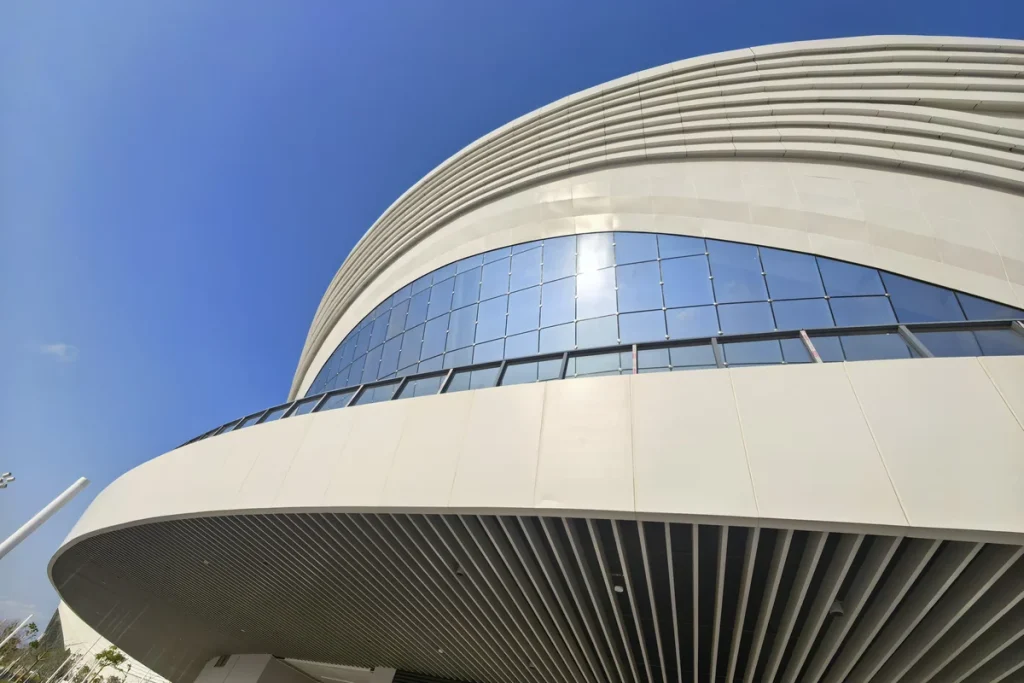
Botswana Sports Arena
A medium-sized comprehensive sports and cultural venue seating around 8 000, designed as a regional landmark in Botswana. The facade needed to combine a transparent, modern glazed face with bold three-dimensional aluminium paneling, on a budget that balanced cost with visual impact.
Open project recordPhotos are enough to begin
Start with the minimum useful brief.
For a project-specific answer, send the information available now. We will identify the missing inputs instead of asking you to complete the design before the first conversation. If drawings are unavailable, clear photos and rough dimensions are enough to begin.
- Destination city, governing specification and appointed consultant
- Proposed glass, aluminium, coating and interface build-up
- Known wind, thermal, acoustic, fire or water criteria
- Available reports, calculations and approval comments
- Party responsible for local review, stamping and submission
Decision summary
The essentials
- Match evidence to the exact proposed build-up.
- Record editions, pressures and acceptance criteria.
- Separate testing from local approval.
- Budget new testing and third-party review explicitly.
Compliance is strongest when every document has a stated purpose, limitation and owner. Ask what a report covers, what remains project-specific and who will present the final evidence to the destination authority.
Standards and references
Standards and references
Confirm the governing edition and project applicability with the appointed consultant and authority.
Rank Math FAQ block
Frequently asked questions
Is CE marking enough for a GCC or North American project?
No universal document replaces the destination project’s specification and approval path. European evidence may be relevant technical support, but local consultants must confirm whether it is accepted and what additional calculations, tests or registrations are required.For both regions, CE marking is only one of the facade certifications reviewers expect to see.
What is the difference between a test report and a certificate?
A test report records how a defined specimen performed under stated conditions. A certificate may address conformity or an assessed product scope. Neither should be assumed to cover different dimensions, glass or interfaces without review.
Does G-Mark certify every curtain wall for the GCC?
No. Applicability depends on product category, destination and current regulatory scope. SASO/Saber, product classification and local authority requirements must be checked by the appointed local team for the actual goods and project.
Who pays for project-specific testing?
The commercial scope should say. New laboratory tests, witnessed mock-ups, consultant review, local stamping, authority fees and registrations are included only when expressly priced and assigned before order.
Which facade certifications should a supplier provide by default?
As standard: system test evidence to EN 13830 or ASTM E283/E330 for the proposed configuration, a current ISO 9001 certificate covering the actual production site, and product-specific reports for any claimed performance. Project-specific testing — mock-ups, site conditions, local approvals — is priced and scheduled separately.
Is CE marking on a curtain wall the same as full compliance?
No. CE marking curtain wall systems declares performance under harmonized EN standards, but it does not replace project-specific engineering, structural calculations for the actual span loads, or the local approvals — G-Mark, Saso, municipal letters — each destination requires.
About the author