Five numbers decide whether the spec is real
| Indicator | What it measures | Test or rating route | What the project specification must state |
|---|---|---|---|
| U-value | Heat flow through the whole assembly | NFRC 100 or the adopted EN/ISO calculation route | Whole-wall boundary, units, calculation standard and acceptance value |
| SHGC / g-value | Solar heat admitted through the glazing | NFRC 200 or the adopted regional route | Project climate, glass build-up and required rating |
| Air tightness | Leakage through joints and seals | ASTM E283/E283M or EN 12153 | Specimen size, reference pressure and maximum leakage |
| إحكام مقاومة نفاذ الماء | Resistance to wind-driven rain | ASTM E331 or EN 12155 | Project-derived pressure, duration and definition of failure |
| Structural | Wind capacity, anchors and serviceability | ASTM E330/E330M or the governing project method | Zone pressures, load combinations and member/glass deflection limits |

Curtain wall performance requirements belong in the contract in exactly this form: indicator, value, method, and the document that proves it. A high performance curtain wall specified this way can be accepted or rejected on evidence, which is the entire point of writing it down.
U-value and SHGC: the energy pair
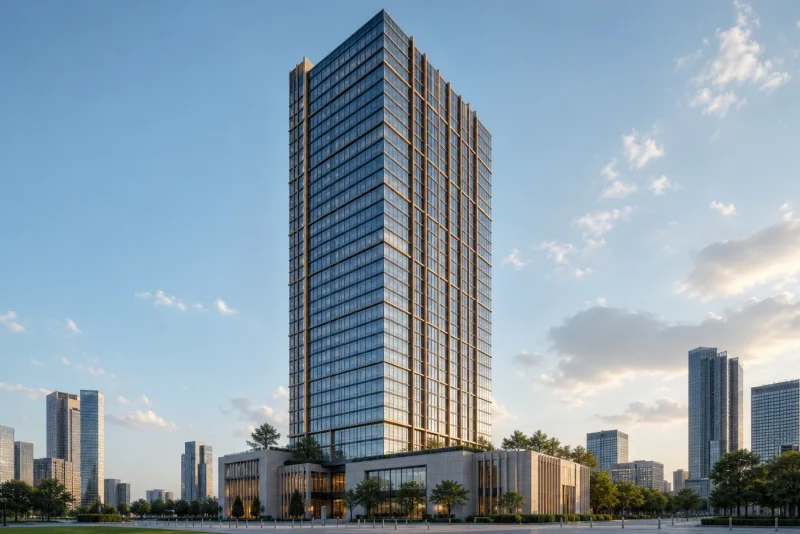
On the 18,000 m² Foshan Tianyue Mixed-Use Tower, a delivered 40-storey unitized envelope in Foshan’s Qiandeng Lake CBD completed in 32 weeks ex-works, the whole-building U-value held at 2.0 W/(m²·K) for the curtain wall and 1.6 W/(m²·K) for the hotel premium zones, with double-silver and triple-silver Low-E units pushing centre-of-glass values to 1.4 W/(m²·K). SHGC is the other half of the pair. In cooling-dominated climates a high performance curtain wall lives or dies by how much sun it admits, and our GCC thermal performance guide covers that arithmetic region by region. Buyers should always ask which of the two numbers a quote is actually quoting, and whether the U-value is whole-wall or centre-of-glass, because the gap between those two figures is where optimistic brochures live.
Air and water: the weather pair
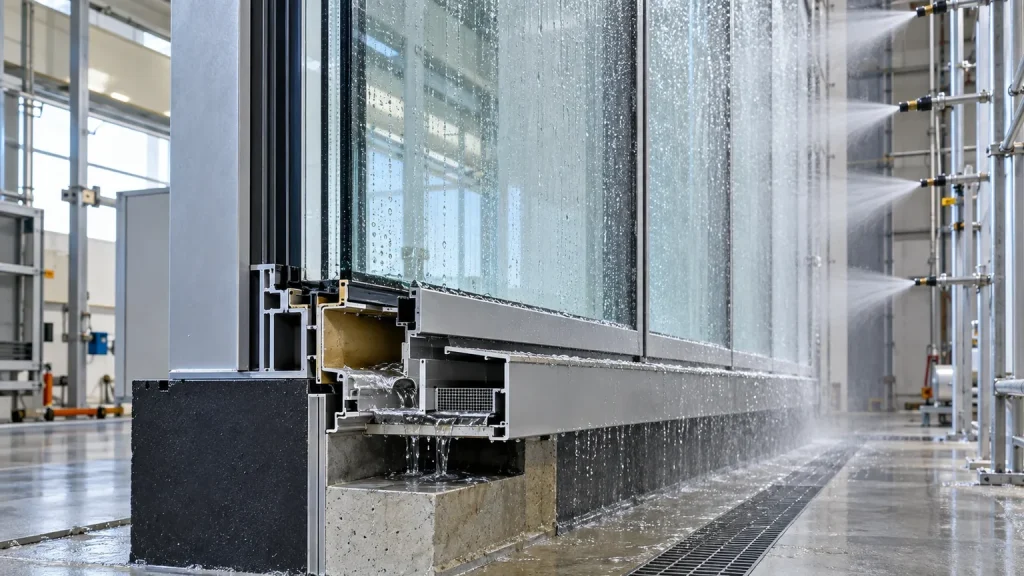
Air leakage is the quiet energy thief and water is the loud one. The Tianyue perimeter runs a three-seal EPDM gasket line on every unit, with a wider 12A cavity on the road-facing elevations, and the same pressure-equalised drainage logic scales from a villa to a tower.
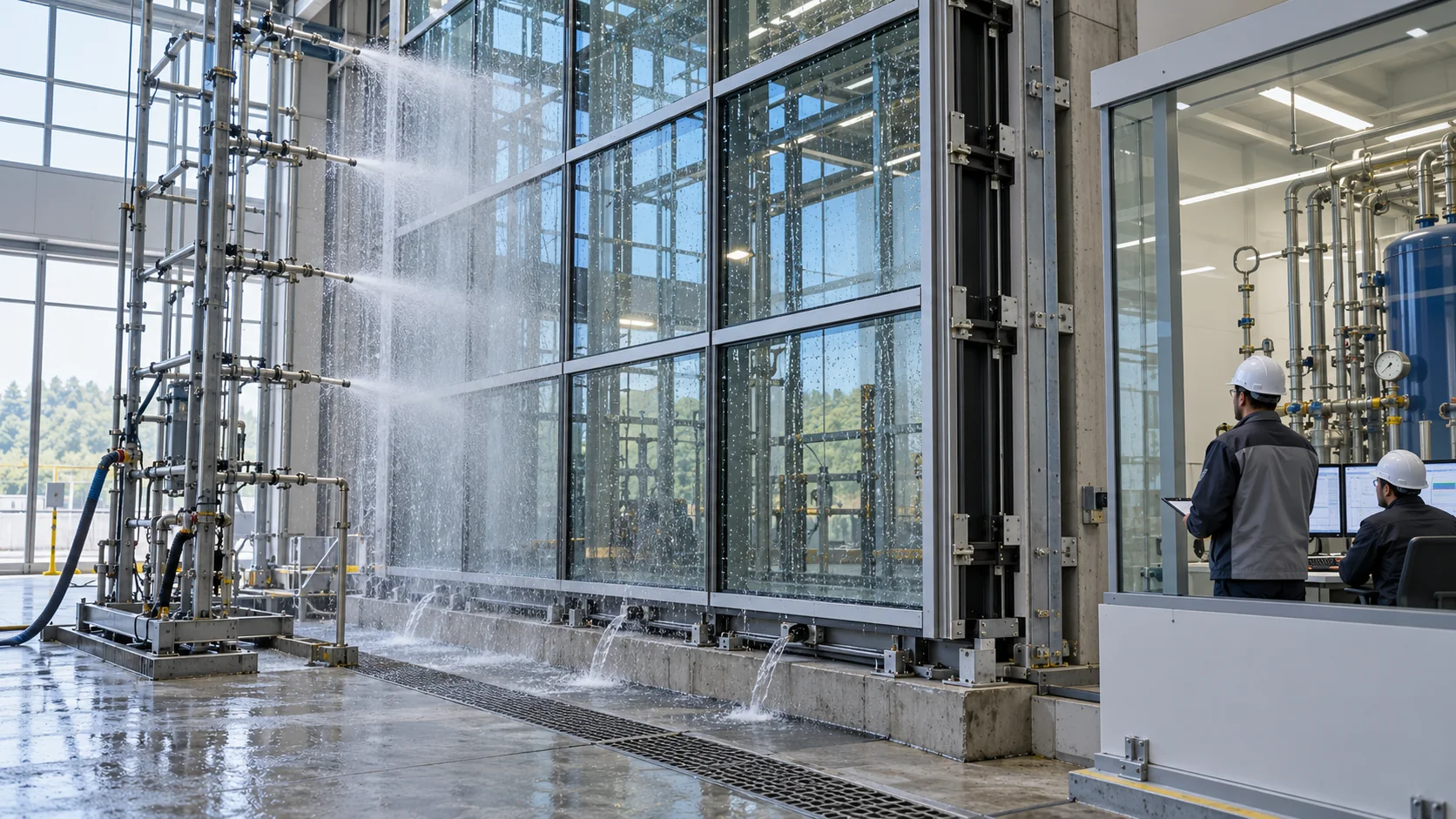
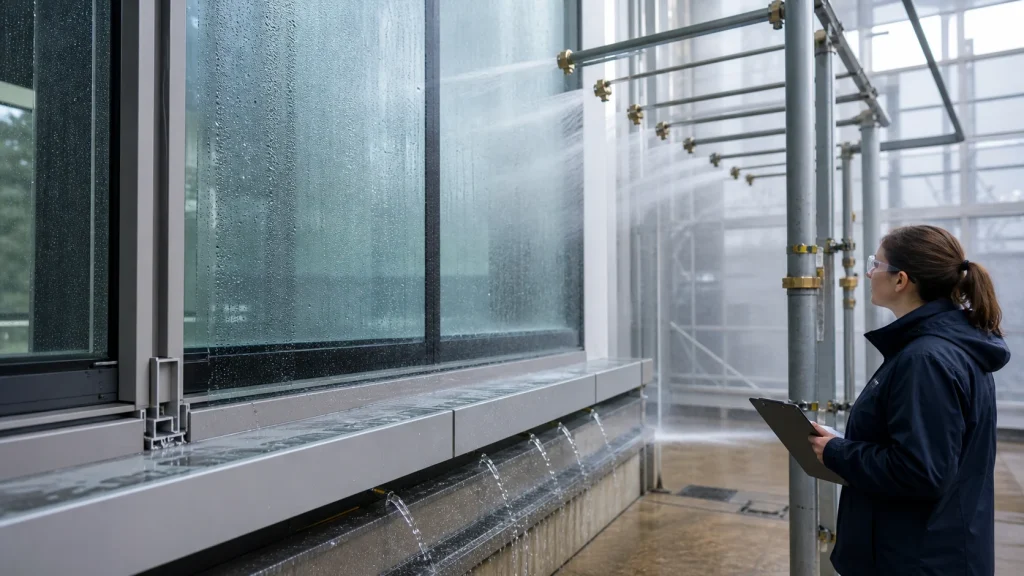
ASTM E331 testing is meaningful only when the pressure, duration, specimen and failure criteria come from the project specification; 720 Pa is one possible project value, not a universal threshold. The construction detail behind these numbers, from thermal breaks to warm-edge spacers, is covered in our guide to the insulated curtain wall. A facade that passes the laboratory but leaks at a site joint has still failed in service.
Structural capacity: a high performance curtain wall stands up to its wind
Structural performance is specified by wind zone, load combination and the governing code, then tested or calculated under the stated route such as ASTM E330/E330M. Framing and glass deflection limits must come from that project specification; L/175 or an absolute cap may appear in some briefs, but neither should be assumed universally. Corner zones often carry higher suction than field zones, which is why the pressure map matters more than the elevation render. In typhoon markets, impact, pressure cycling and anchorage can also join the brief. Buyers should confirm that every calculation uses the project’s own wind report, member span and support condition.
Acoustics: the fifth number buyers forget
The Tianyue tower fronts a major CBD road, and its acoustic line of Rw 35 to 45 dB across apartments and hotel rooms was verified by calculation against the glazing build-up and the gasket system. That number belongs in the same specification table as the U-value, because a facade that passes energy review and fails the bedroom is still a failed facade. Laminated interlayers, asymmetric glass thicknesses and wider cavities are the levers, and our guide to facade acoustics for venues and busy roads explains how Rw and OITC targets translate into glass and frame choices. A high performance curtain wall brief that omits acoustics is a brief that will be reopened at the first occupied floor.
Writing a high performance facade specification that can be enforced
A high performance facade specification reads as a table, not an essay: each indicator with its value, its test method, and the acceptance document named. Reference the standards by number, state whether values are whole-wall or centre-of-glass, and define the mock-up scope that will prove the assembly before production. A reference study on record for a Riyadh BIPV villa, 590 m² of envelope over two storeys, shows the discipline at smaller scale: laminated photovoltaic units with warm-edge spacers for cold desert nights, hour-by-hour daylight modelling behind the semi-transparent cells, and performance data handed to the local consultant for review. On towers the same specification logic sits inside the system decisions covered in our high-rise curtain wall decisions hub, where zone mapping decides which values apply to which floors.
What proof travels with the shipment
The evidence file behind a high performance curtain wall contains the thermal report or NFRC rating, the mock-up test report naming the standards passed, material certificates traceable to each batch, and the first-article inspection record. Every unitized panel we ship is numbered and traceable to its material certificates, and our outgoing inspection measures 100% of key dimensions on every profile with AQL batch sampling under GB/T 2828.1, six extrusions per batch going to laboratory testing against GB/T 5237 and GB/T 14846. If a supplier cannot show this file before production, the performance figures are aspirations with a price list attached.
Send the climate file, not just the drawings
Send the Starveil Facade engineering desk the elevations, the project location with its climate zone, the local energy code or target rating, and any acoustic or structural criteria the authorities have set. Ask back for the five-indicator table filled with values, methods and evidence documents for your high performance curtain wall, plus the mock-up scope that will prove them before production. The speed and the substance of that answer will tell you what kind of supplier you are talking to.
What to carry forward
- Five indicators: U-value, SHGC, air, water, structure, with acoustics joining them on occupied buildings.
- Every number in the specification needs a test method and a document behind it.
- Buy whole-wall values; centre-of-glass is a component number, not a building number.
- Zone maps decide corner, crown and podium details before production, not on the hoist.
- A high performance curtain wall is accepted on evidence, from the mock-up report to the numbered unit.
Explore More Curtain Wall Engineering Guides
For a broader understanding of curtain wall engineering and performance requirements, explore our Engineering & Performance hub. For more detailed technical guidance, read our articles on thermal performance for facades in hot-desert climates, facade mock-up testing before production, and facade certifications, ASTM standards and local approvals. These guides explain how to evaluate whole-wall thermal performance, verify air, water and structural resistance through representative testing, and ensure that every performance claim is supported by relevant technical evidence.
الأسئلة الشائعة
What is a high performance curtain wall?
A high performance curtain wall meets stated values for U-value, SHGC, air tightness, water tightness and structural capacity, each proven by a named test method such as NFRC 100, ASTM E331 or ASTM E330. The label means nothing without the numbers and the reports behind them.
Which standards apply to high performance curtain wall systems?
NFRC 100 and NFRC 200 cover thermal and solar ratings, ASTM E283 and ASTM E331 cover air and water, ASTM E330 covers structural performance, and CWCT methods serve the UK tradition. EN 12153 and EN 12155 provide the European route for air and water tightness.
How do whole-wall and centre-of-glass U-values differ?
Centre-of-glass measures the insulated glazing unit alone, while whole-wall adds the frame, the edge zone and the spandrel. On the delivered Foshan Tianyue tower, centre-of-glass reached 1.4 W/(m²·K) with double-silver and triple-silver Low-E units, while the verified whole-building figure was 2.0 W/(m²·K) for the curtain wall and 1.6 W/(m²·K) in the hotel premium zones.
Does a high performance curtain wall cost more?
Per square metre of facade, usually yes. Per year of operation, the energy and maintenance arithmetic often closes the gap, particularly in cooling-dominated climates where SHGC drives plant sizing. The premium buys verified performance and its evidence file, not appearance.
Can a stick system reach high performance levels?
Yes, provided the thermal break, glazing build-up and sealing are engineered to the same targets. Unitized construction makes factory control easier, but a well-built stick facade with pressure-equalised drainage and a verified mock-up can meet identical values.
What documents should a supplier provide before production?
The mock-up test report naming the standards passed, thermal calculations or NFRC ratings, material certificates tied to batch numbers, and the first-article inspection record. Together these form the acceptance baseline for the whole order.
عن الكاتب