Three finish families, one exposure question
| إنهاء | Film thickness (typical) | Class | Colour hold | Where it belongs |
|---|---|---|---|---|
| PVDF, 2-coat | 25 to 30 µm | AAMA 2605 | ~10 years to stated colour and gloss limits in high-UV exposure | Coastal, riverside, high-UV and dusty environments |
| PVDF, 3-coat | 30 to 40 µm | AAMA 2605 premium | Clearcoat protects metallic and deep colours | Colour-critical landmarks, metallic effects |
| Powder | 60 to 120 µm | AAMA 2604 | ~5 years to stated limits | Inland commercial work, moderate climate |
| Anodizing | 15 to 25 µm (AA15 to AA25) | Class I / II per AAMA 611 | Does not chalk; tone shifts slowly | Metallic look, high-touch interiors, limited colour range |
The table reads as a selection tree once the exposure map is drawn: salt spray and UV push the decision to PVDF coating at AAMA 2605 class, budget and inland exposure allow 2604 powder, and anodizing enters only when the design intent is the metallic itself. The substrate matters too, because finish performance starts with the alloy under it; that choice is covered in our 6061 vs 6063 aluminum grade guide.
Resin share is the number that separates the classes
Two suppliers can quote “fluorocarbon” at prices far apart, and the difference is usually resin content. A PVDF coating only performs to AAMA 2605 expectations when the topcoat carries at least 70 percent PVDF resin, typically licensed under names such as Kynar 500 or Hylar 5000; 50 percent content belongs to the 2604 class and behaves like it. Ask for the resin licence in writing, because the licence name, not the word fluorocarbon, is what a laboratory checks. Colour hold is then quantified: after the stated exposure period, chalk and fade are judged against defined limits, commonly a colour difference of no more than 5 ΔE units for 2605-class work.
PVDF coating vs anodizing: two answers to the same weather
The PVDF coating vs anodizing comparison is often framed as durability, but it is really about intent. Anodizing converts the aluminum surface itself into a hard oxide layer, 15 to 25 µm deep in architectural classes, and it cannot peel because there is no separate film; its limits are colour, since the palette runs metallic silver to champagne and bronze, and batch uniformity, since tank chemistry drifts between lots. A PVDF coating offers thousands of colours, can be batch-matched to a reference, and can be touched up in the field. The failure modes differ: anodizing pits where the oxide runs thin in salt air, while PVDF loses gloss years before it loses colour. Long runs of identical panels read best anodized; colour-critical elevations read best PVDF.
Film thickness and colour difference: the numbers that survive an audit
Finish disputes are settled with two instruments. A magnetic or eddy-current thickness gauge reads the dry film on any delivered profile: 25 to 30 µm for two-coat fluoropolymer work, and readings below that on faces are a rejection, not a negotiation. A spectrophotometer reads colour against the approved sample, expressed as ΔE: values under 1 are indistinguishable to most eyes at facade distance, and contracts commonly accept 1 to 2 ΔE batch to batch.
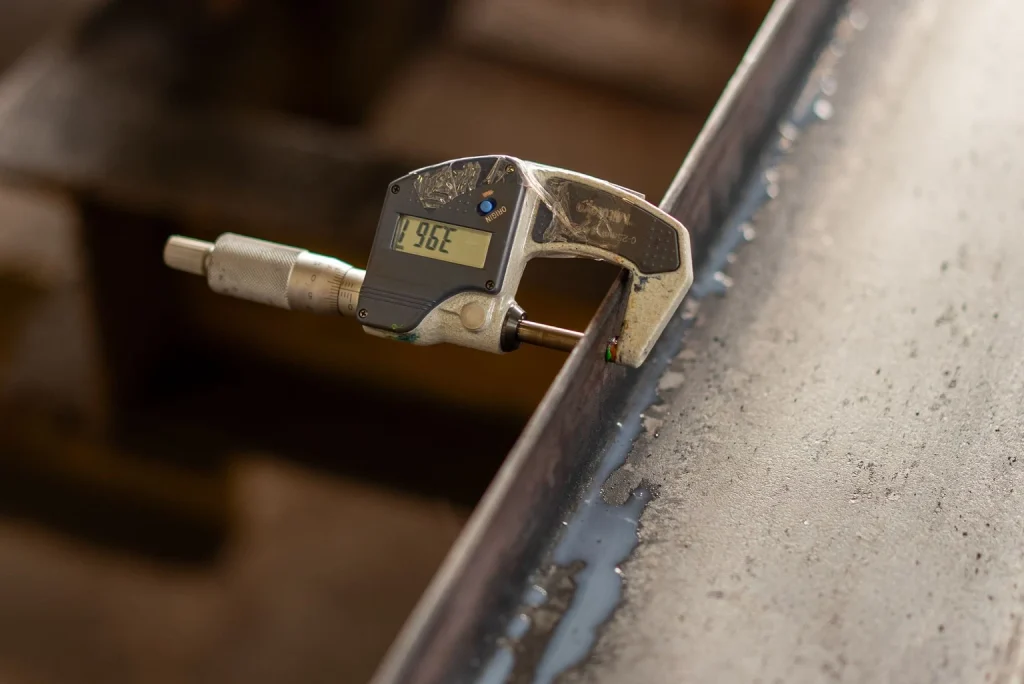
Specify both numbers in the purchase order, with the measurement points named, because a finish that passes on paper but was never gauged is a colour argument waiting for year three.
A riverside envelope in the dust season: the Baghdad record
Dust changes the finish calculus. A study on record for the Baghdad riverside residence, an 860 m² stick curtain wall envelope facing 50 °C summers and dust-storm seasons on the Tigris, specified PVDF-coated framing and pressings precisely because dust is an abrasive: airborne grit cleans itself off a smooth fluoropolymer film with rain and wind, while it dulls softer paints and scratches anodic films at hand height. The same envelope pairs the glazed river frontage with a deeply recessed perforated screen street frontage, a shading logic our mashrabia facade system carries to its extreme. The record shows the finish class being chosen the way it should be: by measured environment, not by sample-board appeal.
How coastal projects choose: the class tree in practice
Draw the exposure map first. Inland low-rise work with sheltered elevations sits at AAMA 2603, general commercial work at 2604 powder, and the coastal, marine-adjacent and high-UV set at 2605 PVDF class. Fixing methods follow the same exposure, because salt attacks fasteners before it attacks panels, as our coastal structural glazing fixing guide sets out, and wind-driven debris environments add their own requirements covered in our typhoon-rated glass walls guide. The full salt and sand durability picture, including gaskets and hardware, is in our salt and sand facade durability guide. One map, one class decision, applied consistently across coating, fasteners and seals.
What the finish warranty actually warrants
An AAMA 2605 finish warranty is a colour and gloss instrument: it warrants that chalk, fade and gloss loss stay within stated limits over a stated period, typically 10 to 20 years, benchmarked on defined exposure. It does not warrant against abrasion from windborne grit, against cleaning with unspecified chemicals, or against cut-edge corrosion where profiles were field-cut and left bare. Ask for the warranty text with the class reference in it, and check the exclusions against the building’s real maintenance plan before the deposit. A warranty that excludes the site’s actual weather is a finish discount, not cover.
Send the weather the building will face, ask for the class in writing
Send the site location, the distance to salt water if relevant, the prevailing dust or pollution conditions, and the colour references per elevation. Ask back for the finish specification per elevation: class, resin content or licence, coat build, target dry film thickness, and the ΔE acceptance band against the approved sample. A PVDF coating specified at that level of detail cannot be substituted silently. Starveil Facade issues finish schedules in exactly that structure from the Foshan plant.
What to carry forward
- Class follows exposure: 2603 inland, 2604 general commercial, 2605 for coastal, high-UV and dusty sites.
- A PVDF coating earns its 2605 class only at 70 percent or higher resin content; ask for the licence name.
- Gauge the film and read the ΔE: 25 to 30 µm and an agreed colour band belong in the purchase order.
- Anodizing is an intent, not a budget alternative: metallic, hard, narrow in colour, and batch-limited.
- Read finish warranty exclusions against the site’s real weather before the deposit, not after year three.
RELATED READING
Choosing the right aluminum facade finish requires more than comparing coating thickness and colour retention. Explore our aluminum doors, windows and facade systems hub for a broader overview of architectural envelope solutions. For more detailed guidance, read our الملح والرمال والأشعة فوق البنفسجية: متانة واجهات المباني في ظروف الخليج guide to understand how environmental exposure affects coatings, fasteners and seals, our أولويات مواصفات الواجهات للمباني في دول مجلس التعاون الخليجي guide for project-specific material and performance requirements, and our Climate Responsive Facades Engineering for the Gulf guide to explore how facade finishes, shading systems and materials work together in demanding climates.
How does PVDF coating vs anodizing compare for coastal facades?
How does PVDF coating vs anodizing compare for coastal facades?
The fluoropolymer wins on colour retention and repairability in salt environments, and its 2605 class carries the longest colour expectations. Anodizing resists chalking because there is no organic film to chalk, but thin oxide in salt air can pit, and its narrow colour range cannot be batch-matched. Coastal work that needs colour freedom chooses PVDF; coastal work that needs the metallic look chooses anodizing at Class I thickness and accepts the maintenance that follows.
What film thickness should a PVDF coating have?
Two-coat work runs roughly 25 to 30 µm dry film, primer and topcoat combined; three-coat systems with a clearcoat reach 30 to 40 µm for metallic and deep colours. Readings should be taken with a gauge at agreed points; results below the band on visible faces are a rejection, not a discount conversation.
Is powder coating acceptable for coastal projects?
Generally not on marine-facing elevations. Powder at AAMA 2604 class holds colour for roughly five years to stated limits, which salt spray, UV and abrasion consume faster than the warranty expects. Powder has a legitimate place on inland commercial work and interior faces; the mistake is letting a 2604 price onto a 2605 elevation.
What does an AAMA 2605 finish warranty cover?
Colour and gloss: chalk, fade and gloss loss within stated limits over the warranted period, commonly 10 to 20 years on defined exposure. It excludes abrasion, chemical attack from unapproved cleaning, and field-cut edges left uncoated. Read it as a colour instrument, and check the exclusions against the maintenance manual.
Can PVDF coated aluminum panels be repaired on site?
Small scratches and touch-ups are workable with matched liquid repair kits, which is one of the practical advantages of the finish over anodizing, where a patch shows. Larger damage is resolved by replacing the affected panel, and the original colour reference and class records are what make a year-eight replacement match a year-one elevation.
How long does a PVDF coating last in a hot, dusty climate?
Long enough that finish class stops being the risk item. The Baghdad riverside residence study on record, an 860 m² stick curtain wall envelope with PVDF-coated framing and pressings, chose the finish for exactly this weather: 50 °C summers and abrasive dust seasons, on a 16-week ex-works design-supply programme. A 2605-class PVDF coating in that environment holds its colour and cleans itself with rain, where softer paints dull within a few seasons.
عن الكاتب