In this guide
- The design basis in the Philippines and Vietnam
- From local design pressure to product selection
- Six layers of a typhoon-capable specification
- Glass, retention and what lamination actually buys
- How the load actually travels
- What one test report can and cannot prove
- What to send and what to ask back
The design basis differs between the Philippines and Vietnam
In the Philippines, facade wind loading follows the project’s applicable National Structural Code of the Philippines and the National Building Code. Site wind data and authority approval are handled by the locally licensed team. In Vietnam, natural-condition data and load criteria sit in separate documents. QCVN 02:2022/BXD provides climate and natural-condition data, while TCVN 2737:2023 is the load code. Specifying typhoon rated glass walls from one market’s assumptions into the other is a common source of under-specification.
| السوق | Local design basis | Factory input | Local-team responsibility |
| Philippines | Applicable NSCP and NBCP criteria with project wind data | System calculations, glass and hardware selection, test mapping | Site design pressures, code interpretation, authority submission |
| Vietnam | QCVN 02:2022/BXD natural data with TCVN 2737:2023 load criteria | System calculations, test evidence, fabrication documents | Code interpretation, approval, licensed review |
From local design pressure to product selection
Starveil Facade develops system calculations and product selections from project criteria issued or approved by the appointed local structural engineer. Final code interpretation, site design pressures and authority approval remain with the locally licensed project team. This division of responsibility is not a limitation. It is how typhoon rated glass walls stay approvable, and the earlier the supplier joins that loop, the fewer specification conflicts reach fabrication.
Six layers of a typhoon-capable specification
| Layer | What to require |
| Local design criteria | Positive and negative design pressures from the governing local code, with terrain category and building height stated |
| Tested configuration | Test evidence at a specimen size, panel count and opening type relevant to the quoted product |
| Glass and retention | Build-up with laminated position, interlayer type and coating named; post-breakage retention reviewed |
| Frame, hardware and anchors | Multi-point locks, interlocks, rollers or pivots, perimeter frame and anchor pattern sized to the load |
| Air and water | Water penetration evidence for the assembled configuration, not the profile alone |
| Impact and cyclic criteria | Debris-impact and cyclic-pressure testing where the project’s risk assessment or code requires it |
Each layer is a separate engineering decision, and a specification for typhoon rated glass walls only holds when all six trace back to the same load case. The system hub for villas and resorts treats wind capacity as one input among many sizing questions. See sliding and folding glass walls for villas and resorts for the wider decision frame, and the sliding and folding glass wall systems page for the configurations those calculations start from.
Glass, retention and what lamination actually buys
Laminated glass helps typhoon rated glass walls retain fragments after impact, which matters where wind-borne debris is a design event. It does not by itself guarantee that the house stays dry or that the opening remains weathertight after a pane breaks. Envelope integrity after breakage depends on glazing retention, edge bite, the frame, the anchorage and, where the project requires it, post-impact cyclic-pressure testing. The laminated pane position, interlayer type, thickness and coating placement are project decisions made with the thermal and debris criteria on the table.
How the load actually travels
Wind pressure acts on the glass and transfers through the glazing retention, the sash or panel frame, the interlocks and operating hardware, the perimeter frame, the anchors and the supporting structure.
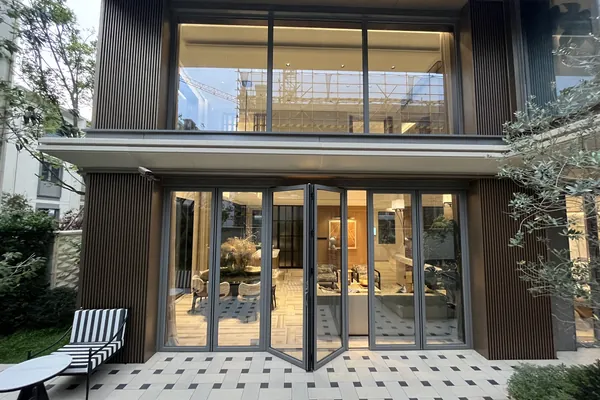
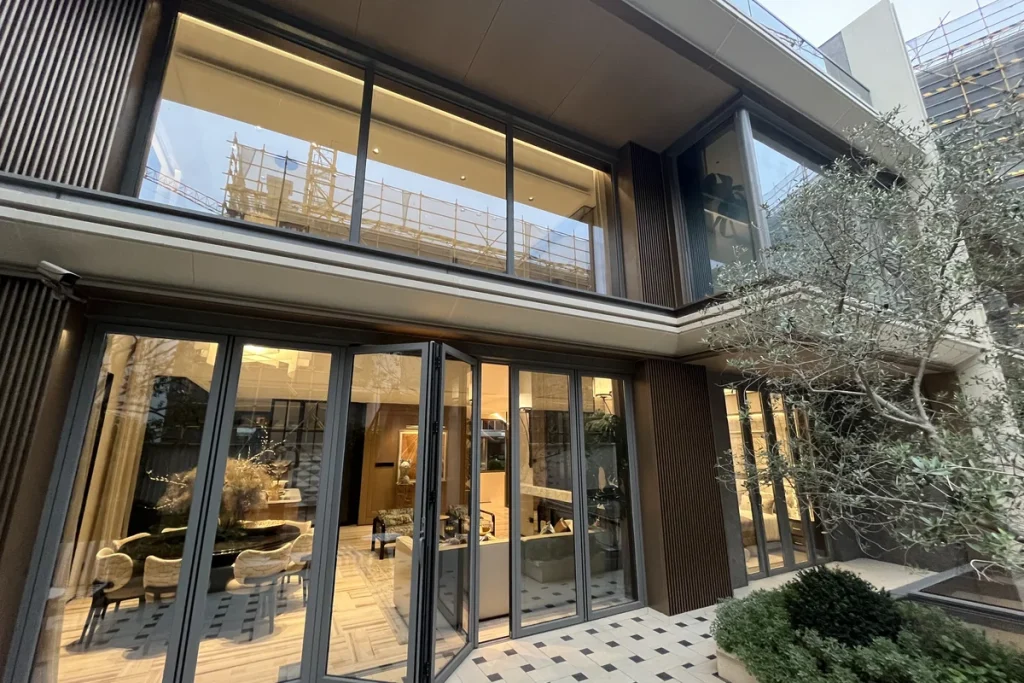
In typhoon rated glass walls, multi-point locking matters because it constrains the operable leaf at several heights and keeps the seals compressed. The delivered 320 m² Medan Private Villa windows and doors package, supplied in eleven weeks ex-works for a two-storey North Sumatra residence, shows the hardware and seal chain holding a large operable opening in a hot, high-rainfall tropical climate: a six-panel folding door opens 85 percent of the living room wall on thermal-break aluminium, double-glazed Low-E units, multi-point locking and triple EPDM seals.
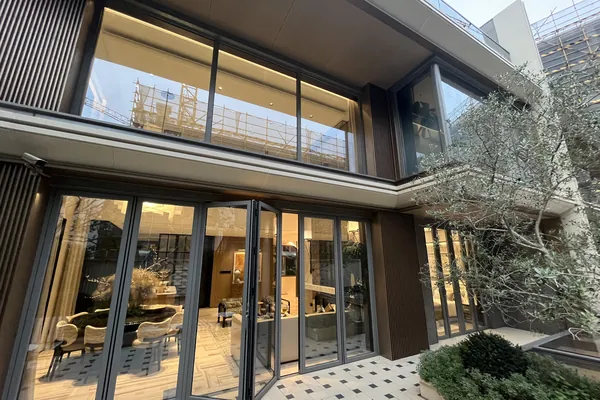
That package is adjacent-climate evidence for large operable openings, not qualification evidence for typhoon rated glass walls on a Philippine or Vietnamese project. On the delivered Long Island pool enclosure, our supervising engineer checked the head-track alignment and the first-panel water test on site. The support side of the chain fails as often as the product side. For the structural-glazing side of that same path, our guide to frameless facades under wind and seismic loads follows the chain through glass, fittings and anchors.
What one test report can and cannot prove
| Criterion | Typical method | The report proves | The report does not prove |
| Structural performance under uniform static pressure | ASTM E330 | The specimen held the applied pressure difference | Behaviour under debris impact, cyclic loading or site-specific gusting |
| Water penetration, laboratory | ASTM E331 or ASTM E547 | No uncontrolled water penetration at the stated pressure and spray rate | Performance of a different configuration or a poorly installed site assembly |
| Water penetration, field | ASTM E1105 | The installed assembly on this project resisted the stated exposure | Other installations without the same quality control |
| Debris impact and cyclic pressure | ASTM E1886 with ASTM E1996 | The specimen survived the impact and pressure sequence | Anything about projects outside the tested scope |
Where a project requires typhoon rated glass walls to carry impact and cyclic evidence, the test programme should be confirmed with the local engineer early. Monsoon and typhoon are different problems, and the evidence for each should say which one it addresses. On a delivered Chiang Mai villa in monsoon Thailand, bedroom awning windows gave the family secure night ventilation through months of tropical rain. It was a hardware decision made for the climate rather than the catalogue.
Send the site. Ask for documents, not adjectives
Give your supplier the location, the building height and the exposure. Ask for six things in return: the positive and negative design pressures with the load basis, the tested specimen size and configuration, and the test standards and report numbers. Then ask for the water test pressure, the hardware schedule and the anchor pattern. Starveil Facade returns those as calculation and test-mapping documents for the appointed local engineer to review. The wider question set before signing sits in our supplier checklist. That document trail is what separates typhoon rated glass walls from doors sold on a number.
ما يجب تذكّره
- There is no universal typhoon rating. Suitability is project-specific.
- The Philippines and Vietnam use different design bases for typhoon rated glass walls. Specify from the local code.
- A pressure value needs its governing code, load basis, specimen and report reference.
- Laminated glass buys fragment retention, not a dry house by itself.
- Test reports prove the tested configuration only.
References
- ASTM E330: Standard Test Method for Structural Performance of Exterior Windows, Doors and Skylights by Uniform Static Air Pressure Difference.
- ASTM E331 and ASTM E547: Standard Test Methods for Water Penetration of Exterior Windows by Uniform or Cyclic Static Air Pressure Difference.
- ASTM E1105: Standard Test Method for Field Determination of Water Penetration of Installed Exterior Windows and Doors.
- ASTM E1886 and ASTM E1996: Standard Test Methods and Specification for Performance of Exterior Windows Impacted by Windborne Debris in Hurricanes.
- National Structural Code of the Philippines (NSCP) and the National Building Code of the Philippines.
- QCVN 02:2022/BXD and TCVN 2737:2023, Vietnam.
RELATED READING
For further guidance on selecting and specifying large operable glass openings, explore our sliding and folding glass wall systems and our guide to sliding and folding glass walls for villas and resorts. Before choosing a supplier, use our 24-question supplier checklist to review the key points that should be clarified before placing an order. You can also explore the Medan Private Villa project و Chiang Mai Lanna Villa project to see how large glass openings and window systems are applied in tropical residential settings.
الأسئلة الشائعة
What does typhoon rated mean for a glass wall?
There is no universal typhoon rating. A defensible claim for typhoon rated glass walls means the operable assembly was engineered and tested to stated positive and negative design pressures under the governing local code, with report evidence covering each criterion separately.
Do the Philippines and Vietnam require the same specification?
No. Philippine projects work from the applicable NSCP and NBCP criteria, while Vietnamese projects draw on QCVN natural-condition data and the TCVN 2737:2023 load code. Site design pressures are calculated for each project by the locally licensed team.
Which glass should face the weather in a typhoon zone?
A laminated lite is common where wind-borne debris is a design event, but the pane position, interlayer type, thickness and coating placement are project decisions. Fragment retention after breakage also depends on the frame, the retention details and the anchorage.
What test evidence backs typhoon rated glass walls?
Reports naming the tested configuration, the pressures held, the methods and the report numbers, mapped to the product being quoted. ASTM E330 covers structural performance under static pressure, with water methods such as E331, E547 and E1105 and impact methods such as E1886 and E1996 as separate criteria.
Can sliding or folding systems qualify as typhoon rated glass walls?
Yes. Typhoon rated glass walls can slide or fold when the specific assembly is engineered and tested to the project’s positive and negative design pressures, with debris-impact and cyclic evidence where the code or risk assessment requires it. The tested size and configuration must match what is being quoted. Typhoon rated folding glass walls follow the same rule: the tested leaf count, track and locking hardware must match the quoted configuration. On the delivered Medan villa, a six-panel folding door opens 85 percent of the living room wall on thermal-break aluminium with multi-point locking and triple EPDM seals, holding a large operable opening through a hot, high-rainfall tropical climate. That is adjacent-climate evidence for the hardware chain, not typhoon-zone qualification. The evidence decides, not the product category.
Does the supplier handle code approval in the Philippines or Vietnam?
No, that stays with the locally licensed team. The supplier provides the system calculations, test mapping and fabrication documents behind typhoon rated glass walls for that team to review, while site design pressures, code interpretation and authority submission remain local, as the responsibility table shows.
عن الكاتب