Strip width influences performance, but does not predict it alone
| متغيّر التصميم | Expected influence | Evidence to request | Common comparison error |
|---|---|---|---|
| Continuous aluminium frame | Strong thermal bridge at frame and edge | Whole-window simulation or test for the quoted size | Comparing its glass value with another bid’s whole-window value |
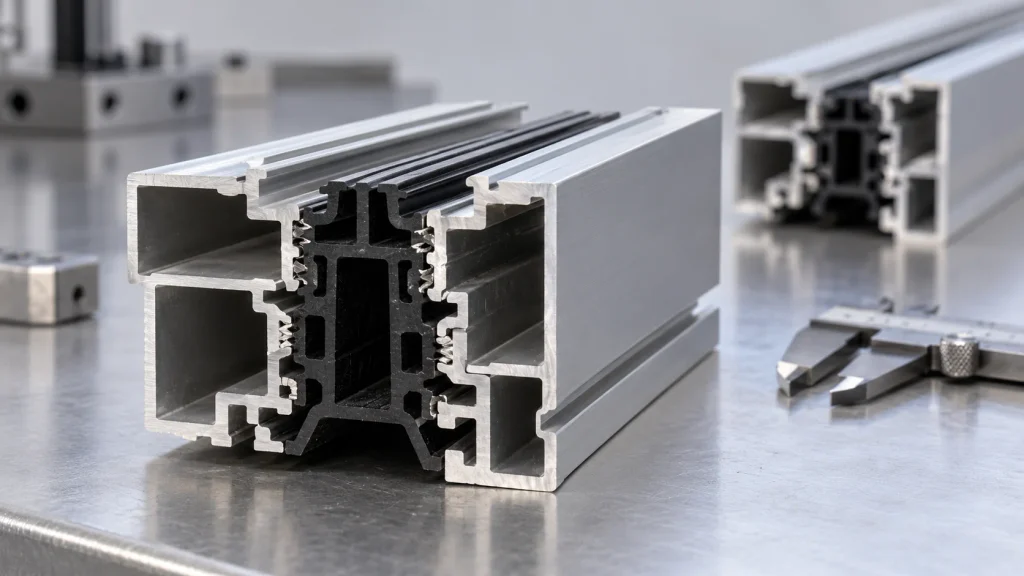
| Polyamide connector width and geometry | Can raise interior surface temperature and reduce frame conductance | Exact section drawing, material declaration and crimp/shear evidence | Assuming two equal-width strips perform equally |
| Spacer and glass build-up | Controls edge temperature, U-factor and solar response | Named spacer, glass make-up and boundary conditions | Ignoring spacer and frame fraction |
| Unit size and operation | Changes frame-to-glass ratio and seal paths | Report covering the scheduled configuration and size Applying one model result to | Applying one model result to every window mark |
| Installation perimeter | Can preserve or bypass the designed thermal line | Interface detail and project-specific condensation review | Treating product performance as installed performance |
For procurement comparisons, hold the window size, glass, spacer and boundary conditions constant, then compare frame alternatives. Published example U-values and cost indices are not compliance evidence for another configuration. The same whole-assembly logic applies to larger envelopes in our insulated curtain wall guide.
What the break actually breaks
In an unbroken frame, the interior and exterior metal are one continuous extrusion, and aluminium’s conductivity of about 160 W/(m·K) moves heat across the section almost unopposed. Thermally broken aluminum windows replace that continuity with a polyamide strip at roughly 0.3 W/(m·K), a material about five hundred times more resistant. Thermally broken window frames also run warmer on the room side, which is why the break is as much a condensation device as an energy device: a frame interior surface held above the dew point never fogs, never drips and never stains the reveal. The procurement detail that matters is the crimp: knurled extrusion jaws rolled onto the strip under controlled pressure, with shear-test evidence per batch.
The cost-performance ledger
The price premium over an unbroken frame is project-specific: section family, strip geometry, glazing, quantity, finish and hardware all move it. The benefit also depends on climate, internal humidity, HVAC operation and local energy requirements. Compare bids using the same whole-window model and a condensation check rather than a generic percentage. Our commercial windows guide shows where this decision sits in the specification hierarchy, and the operable-sash contribution is covered in energy efficient casement windows.
Humidity is the harder test: the Medan delivery
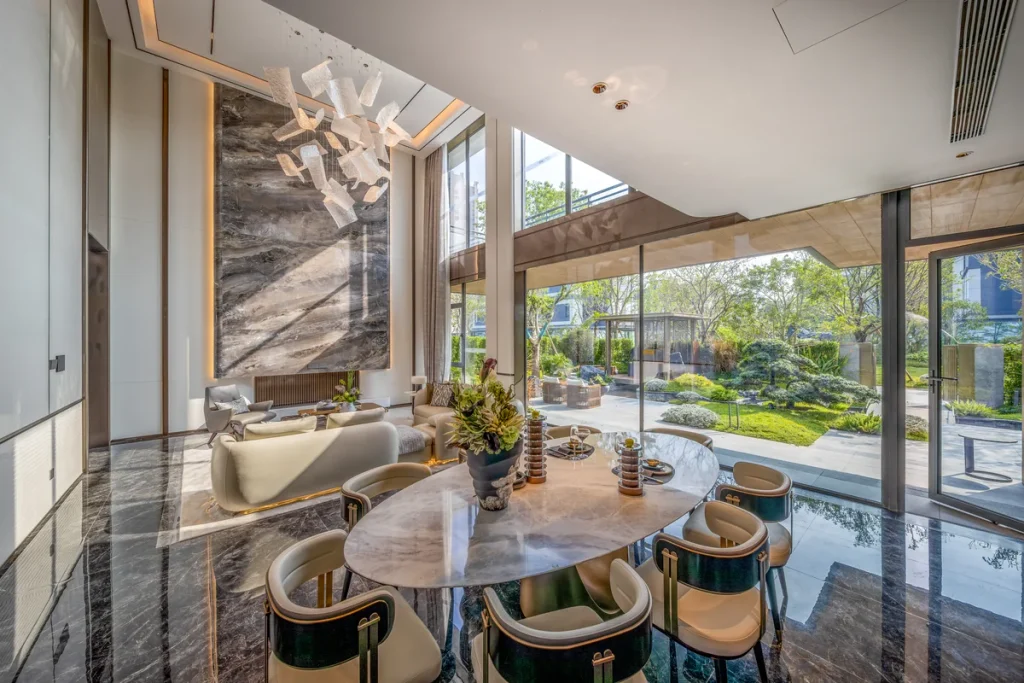
The delivered Medan Private Villa in North Sumatra, a 320 m² windows-and-doors package engineered to drawings by Spatial Art Design, shows the system working at the humid end of the spectrum. Every opening is built on thermally broken aluminum windows and doors: double-glazed Low-E insulating units, multi-point locking and triple EPDM seals throughout, delivered on an 11-week ex-works programme. The principal room is a six-panel folding glass wall that opens 85 percent of the living-room elevation, stacking the panels aside so room and garden read as one space. Through Medan’s monsoon rain and equatorial squalls the seals hold their air and water classes, while the thermal break stops the air-conditioned chill from reaching the outer frame skin, so humid tropical air finds no cold surface to condense on.
Cold-bridge anatomy: where the last heat escapes
Even in a broken frame, three bridges remain. The glazing edge, where the spacer bridges the panes; the hardware zone, where locks and hinges bypass the strip; and the installation perimeter, where the frame meets the structure. Warm-edge spacers lift the glass edge temperature by several degrees, quality hardware keeps its metal mass inside the broken zone, and perimeter insulation with a continuous seal line finishes the job. Buyers comparing thermally broken aluminum windows should ask each bidder to state the spacer type and show the isotherm simulation for the exact section quoted, because two windows with identical strip widths can finish a full point of frame temperature apart.
A second tropical record: Chiang Mai
The delivered Lanna Serenity Villa in the Hang Dong hills above Chiang Mai extends the same logic across 280 m² of windows and doors on a 10-week ex-works programme.
Every opening uses multi-chamber thermal-break profiles in a single deep-grey powder-coat, glazed with 5 + 18A + 5 Low-E insulating units; bedrooms combine side-hung casements with awning lights so monsoon-night ventilation runs secure, and heavy-duty sliders open the principal room to the garden. For Southeast Asian villa and resort programmes the two records argue one point: specify thermally broken aluminum windows once, correctly, and the envelope stops being a maintenance subject. Exposed coasts add a structural layer to the same decision, covered in our guide to typhoon-rated glass walls in the Philippines and Vietnam.
What to ask before signing
Four questions separate real thermal breaks from brochure ones. Is the strip PA66 GF25, who crimps it, and with what shear-test evidence per batch? Is the quoted U-value a whole-window NFRC 100 figure for this exact configuration, or a centre-of-glass number? Which spacer sits at the glass edge? And does the folding or sliding hardware keep its conductive mass inside the broken zone? Sliding and folding walls concentrate all four questions in one product, and our villa and resort sliding-folding guide walks through them, with the system itself on the sliding and folding glass walls product page. A supplier who answers with section drawings and test reports is selling thermally broken aluminum windows; a supplier who answers with adjectives is selling paint.
Send the climate, not just the drawings
Send the elevations, the opening schedule, the project location with its design temperatures, and the humidity profile if the building is conditioned year-round. Ask for section drawings showing strip width and crimp, isotherm simulations for the coldest and most humid design days, and whole-window U-values per configuration. Starveil Facade returns thermally broken aluminum windows proposals with that evidence attached, priced configuration by configuration from the Foshan engineering desk.
What to carry forward
- Glass gets the brochure, but the frame decides the whole-window U-value.
- Thermally broken aluminum windows pay back through HVAC sizing and condensation avoidance, not only through energy bills.
- Strip width matters, but frame geometry, glass, spacer, unit size and installation determine the whole-window result.
- In cooling climates the break stops exterior condensation; in heating climates it stops interior.
- Crimp quality and batch shear evidence are the difference between a break and a gap.
RELATED READING
Choosing thermally broken aluminum windows requires more than comparing glass U-values. Explore our aluminum windows and facade solutions for project-specific options. For further guidance, see our insulated curtain wall systems, facade thermal performance, and sliding and folding glass walls guides to better understand thermal bridging, condensation control and system selection.
الأسئلة الشائعة
What U-value should thermally broken aluminum windows achieve?
There is no universal target. The required whole-window value comes from the project energy model, climate and adopted code, and the result depends on frame series, unit size, operation, spacer and glass. Verify the exact scheduled configuration through a recognised simulation or test route rather than accepting a value inferred from strip width.
Are thermally broken aluminum windows worth it in hot climates?
Yes, and the Medan record shows why: the delivered 320 m² villa package pairs thermal-break frames with Low-E double glazing, multi-point locks and triple EPDM seals, and its six-panel folding wall opens 85 percent of the living-room elevation while the break stops the air-conditioned chill from condensing monsoon humidity on the outer frame skin. In cooling climates the argument is condensation and peak load, not winter comfort.
How wide should the polyamide strip be?
There is no universal strip width for a climate or building type. Select the section through whole-window modelling, interior-surface-temperature checks, structural demands and the adopted energy code. A wider connector can help, but only the exact frame, spacer, glass, size and installation detail can demonstrate compliance.
Can a thermal break carry the structural load of a large folding wall?
Yes, when the strip is PA66 GF25 crimped under controlled pressure with batch shear tests, and when the hardware is engineered for the leaf weights. The Medan six-panel folding wall runs on exactly that build, which is why crimp evidence belongs in the contract file.
What is the difference between a thermal break and a thermal barrier?
Two names for the same idea in thermally broken aluminum windows: a low-conductivity material interrupting the metal path. What varies is execution, from pour-and-debridge polyurethane to rolled-in polyamide strips. Polyamide GF25 dominates quality aluminium systems because it is dimensionally stable and mechanically crimped.
How do I verify a supplier’s claimed U-value?
Ask for the NFRC 100 or equivalent simulation and test report for the exact configuration of the thermally broken aluminum windows on offer: frame series, strip width, spacer and glass build-up. Then cross-check one line against a second supplier’s equivalent configuration. Any figure quoted without the configuration named is a glass-only number wearing a frame’s clothes.
عن الكاتب