In plain terms
Cross-border facade delivery requires one coding chain from approved drawings through panel schedules, QA records, packing lists and installation documents, so the site team can trace every component to an approved decision.
Decision data
ross-border facade delivery control points
| Control point | Required output | Release owner | Failure prevented |
|---|---|---|---|
| Design freeze | Approved drawings, criteria and interfaces | Client and appointed reviewers | Fabricating superseded assumptions |
| Production traceability | Panel schedule, material and QA references | Facade manufacturer | Mixing revisions or unidentified parts |
| Shipment release | Packing list, photographs and documents | Commercial and technical representatives | Unverified or poorly sequenced dispatch |
| Site handover | Survey, storage, lifting and inspection readiness | Main contractor and installer | Damage, misplacement and installation delay |
Swipe horizontally to compare all four columns on mobile.

Freeze the right information
An export facade becomes predictable when geometry, performance criteria, finishes, interfaces and approvals are frozen before fabrication. Shop-drawing approval is not an administrative signature; it is the point where decisions become material, glass and machining instructions.
The installer should review the interface and setting-out information at this stage because the cheapest site problem is the one removed from the drawing.
Turn drawings into a production system
Panel schedules, component identities and revision control connect the approved drawing set to procurement and machining. The same references should appear on fabrication records, packaging and installation documents.
That chain prevents a late revision from becoming a mix of old and new parts inside the same container.
Make QA travel with the shipment
Remote projects need evidence that survives the distance between factory and site. Dimensional checks, material records, finish batches, glazing records and photographs should remain tied to identifiable panels or lots.
A clear dossier helps the client review progress before each stage of cross-border facade delivery, and gives the site team a reference when questions arise during installation.
Pack in installation order
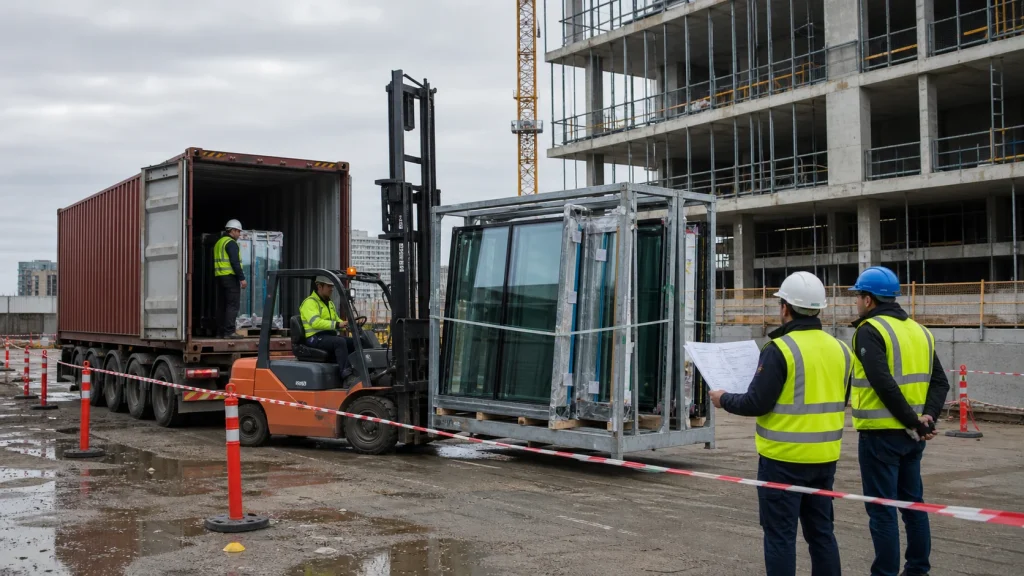
Crates and racks should follow the sequence the site intends to build: elevation, level and bay. Packing lists must use the same names as the panel schedule so the crew does not translate between three coding systems.
The load plan should also respect what must remain accessible first, which components are fragile and which small parts would stop an entire elevation if misplaced.
Write the site boundary before shipping
The contract must name who imports, stores, surveys, sets out, installs, seals interfaces, provides access equipment and signs local approvals. T1 supply, T2 supervision and T3 installation are different scopes, not informal variations of one promise.
A responsibility matrix protects both sides and makes site support faster because every question has an owner.
Project decision note
Use one release register from design to site
Create a release register that joins the drawing list, quantity schedule, procurement status, production batch, inspection record, crate and installation location. Each release should identify the approved revision, affected elevations or bays, materials authorised and open exclusions. This prevents a superseded detail from surviving inside a purchase order or a later drawing comment from being applied to only part of the quantity.
Give the client and installer access to the same status language. Terms such as submitted, reviewed, approved, approved with comments, released for procurement and released for fabrication must have agreed meanings. Comments that affect performance, geometry or quantity should close before release; minor drafting comments can be tracked separately. When progressive releases are necessary, keep a clear boundary between packages and assess how a change in one package affects interfaces with the next.
At shipment, the register becomes the handover index. Panel and crate codes, weights, centres of gravity where needed, packing photographs, inspection status, spares and installation documents should trace back to approved information. On site, receiving checks and non-conformance records should use the same identifiers. This shared chain shortens technical queries and makes warranty investigation possible because the team can reconstruct which decision, material batch and inspection record belong to the installed location.
Archive the register with the as-built drawing set rather than closing it at the end of cross-border facade delivery. Site substitutions, approved repairs and replaced parts must return to the same record if the final handover is to describe the installed facade accurately.

Botswana Sports Arena
A medium-sized comprehensive sports and cultural venue seating around 8 000, designed as a regional landmark in Botswana. The facade needed to combine a transparent, modern glazed face with bold three-dimensional aluminium paneling, on a budget that balanced cost with visual impact.
Open project recordPhotos are enough to begin
Start with the minimum useful brief.
For a project-specific answer, send the information available now. We will identify the missing inputs instead of asking you to complete the design before the first conversation. If drawings are unavailable, clear photos and rough dimensions are enough to begin.
- Drawings or photographs and verified project location
- Approximate quantities, module sizes and release sequence
- Required delivery date and intended port or inland route
- Importer, storage, lifting and access assumptions
- Local installation team and requested T1, T2 or T3 support
Decision summary
The essentials
- Use one coding system from drawing to installation.
- Photograph crates before and after loading.
- Confirm storage and lifting before dispatch.
- Keep technical response routes open during erection.
Distance is manageable when the information chain is stronger than the physical journey. The cross-border facade delivery package should let the site team connect each item to an approved decision and know exactly where to ask when reality differs from the drawing.
Standards and references
Standards and references
Confirm the governing edition and project applicability with the appointed consultant and authority.
Rank Math FAQ block
Frequently asked questions
How should curtain-wall panels be packed?
Protection and rack design should suit glass size, finish, transport route and unloading method. Crates or racks should be ordered by planned installation sequence and use the same identifiers as the panel schedule.
What documents should travel with the shipment?
Commercial and customs documents vary by destination. The cross-border facade delivery handover commonly includes packing lists, panel or component schedules, handling instructions, installation information, material records and agreed inspection evidence.
How are site questions handled across time zones?
Nominate one local technical contact and one supplier contact, agree response channels and mark questions against current drawing references. Consolidated, photographed queries receive faster and safer answers than fragmented messages.
When does shipping risk transfer?
The agreed Incoterm and contract define commercial transfer, but the practical process should also state inspection, evidence, unloading, storage and claims responsibilities. Incoterms do not replace a site logistics plan.
About the author