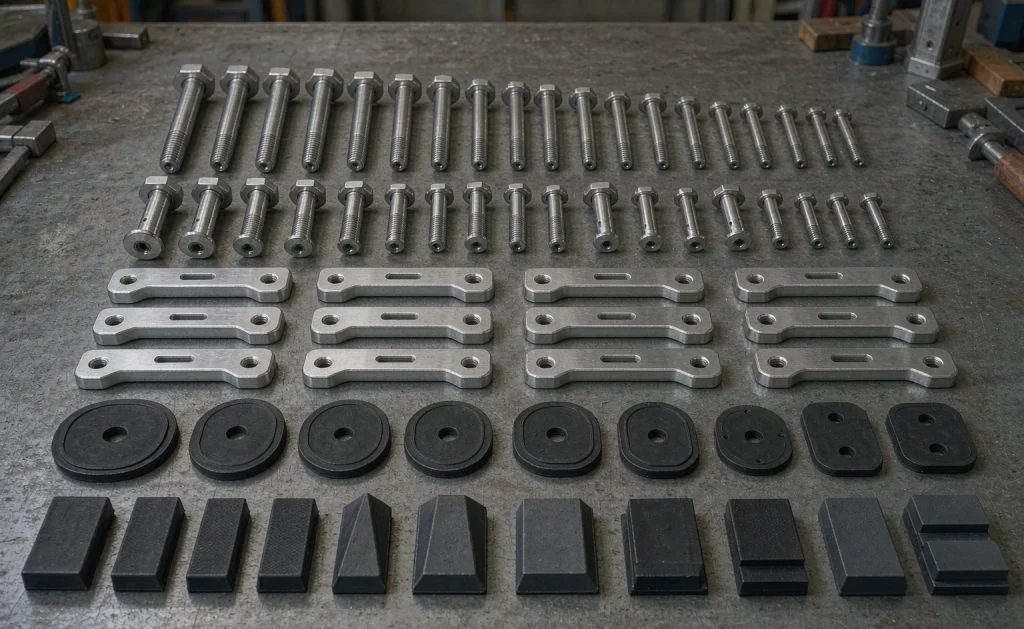
Four stages, one budget
| Stage | Typical deviation sources | Where it is absorbed |
|---|---|---|
| Extrusion | Die wear, profile twist, straightness over length | Mill QC at the press; die management and straightening |
| Machining | Fixture positioning, drill and bore location | CNC program with datum logic; first-article measurement |
| Panel assembly | Frame squareness, glazing bite, cassette geometry | Assembly jigs; staged QA measurement per unit type |
| Structure | Slab edge position, column plumb, anchor zones | Pre-fabrication survey; three-axis adjustable brackets |
RELATED READING
The first three stages of the facade fabrication tolerances stack belong to the factory; the fourth belongs to the building. A programme that controls only its own factory stages still fails on site, which is why the survey is part of fabrication and not a site formality. For how system choice changes the stack, see our guides on stick versus unitized and high-rise facade decisions.
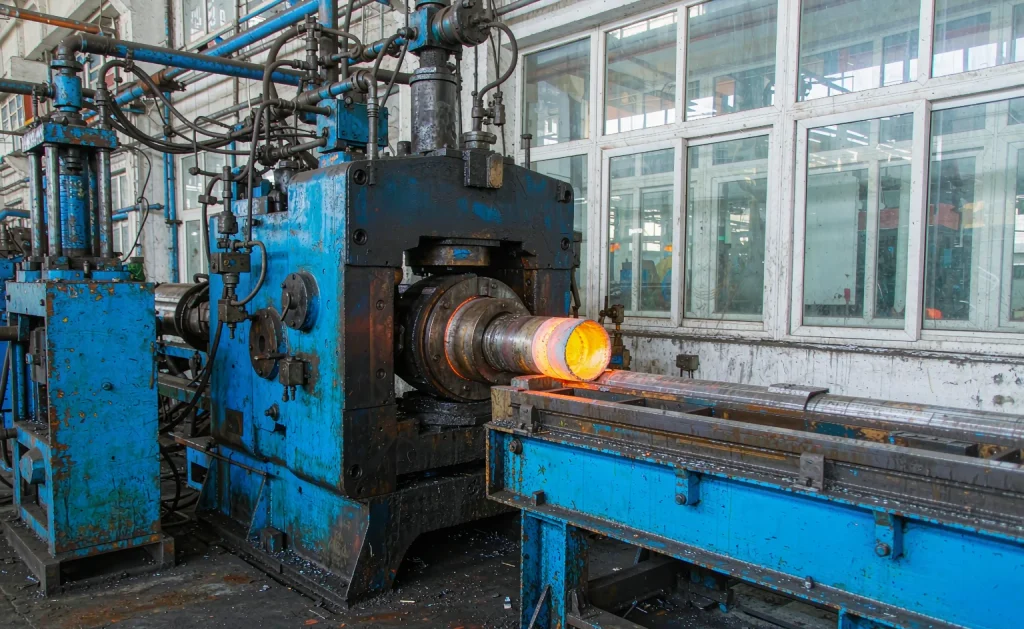
Extrusion: where the stack begins
A curtain wall profile starts as a die and a billet, and the extrusion press gives the profile its first deviations. Those first facade fabrication tolerances are a few thousandths of twist over a six-metre length, straightness within the mill’s standard, and cross-sectional dimensions that drift as the die wears. None of this is a defect; it is the physics of the process, and the press-line QC regime exists to keep it inside the table. Our lines run one 1,800 t press and two 1,000 t presses, extruding 6063 and 6061 alloys. Outgoing inspection measures 100% of key dimensions on every profile, applies AQL batch sampling under GB/T 2828.1, and sends six extrusions from each batch for laboratory testing against GB/T 5237 and GB/T 14846. Drift is therefore caught at the press, not at the machining fixture. That is what an aluminium extrusion tolerance regime looks like in practice: named standard tables, measured profiles and a die history that triggers re-cuts before the budget is spent. The facade manufacturer’s job is to track each die’s history with its partner die maker and order re-cuts before drift reaches the tolerance budget. Profile straightness is bought to suit the joint design, not the price point.
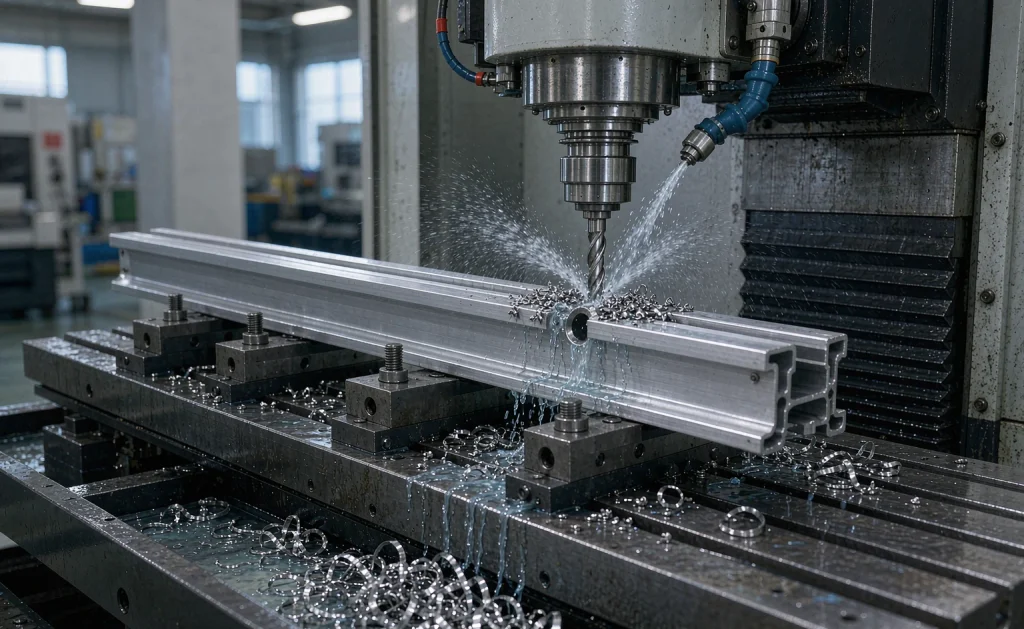
Machining: datums decide repeatability
Machining converts an extruded length into a component with holes, notches and mortises, and its accuracy is a datum problem, the second entry in the facade fabrication tolerances stack. A CNC program that machines every feature from one datum face repeats; one that chains operations accumulates the fixture errors of each step. On the Starveil Facade lines, machining programs are written with datum logic that lets the same profile be drilled for a floor-four panel and a floor-thirty-eight panel with identical relative accuracy. That repeatability is what makes the unit numbering on a tower envelope a real control system rather than a labelling exercise.
The survey is part of fabrication
The most consequential input to facade fabrication tolerances is the position of the building itself. Concrete slabs are poured within their own allowable deviations, columns lean within code, and the facade must still read as a plane. The answer is to survey the as-built structure before fabrication begins and to set the unit grid out against the survey rather than the drawings. On the 18,000 m² Foshan Tianyue Mixed-Use Tower, a 40-storey unitized envelope in Foshan’s Qiandeng Lake CBD designed, fabricated and delivered in 32 weeks ex-works, the slab tolerance survey was taken before any profile was cut, three-axis bracket adjustment absorbed the as-built structure variation, and every unit was numbered and traceable to its material certificates. The installers on floor 34 inherited a resolved problem instead of an open one, and the tower topped out reading as a single calm blue glazed face, which is what balanced facade fabrication tolerances look like from the street.
Brackets: the designed slack
Adjustable brackets are where the remaining facade fabrication tolerances are absorbed. A three-axis bracket at the slab edge allows the panel to be set true in position, elevation and plane while the anchor lands wherever the structure actually is. The adjustment range is an engineering decision sized from the survey data. Too little and the crew runs out of travel; too much and the bracket carries the load through a cantilever it was not designed for. Bracket range, survey data and panel tolerance are one calculation, which is why they belong to the same engineering desk.
First article: the gate that catches everything
The first-article procedure is the last and cheapest place to catch a stacked error. One panel of each type is assembled, measured against the drawings, and signed off before the production run releases. Any datum error, die drift or jig fault that survived the earlier stages appears here as a measurable deviation on a physical object. It is the same artefact discipline described in our delivery milestones guide: a gate confirmed by a dated, signed record rather than a status call. A study on record from our library, a Bangkok design studio’s own building, verified its entrance bay alignment to three millimetres over seven and a half metres. That number was achievable only because the facade fabrication tolerances budget behind it had been balanced stage by stage.
Ask for the stack, not the number
When comparing facade suppliers, ask each one for the facade fabrication tolerances chain. The chain runs from the extrusion standard they buy to, through the machining datum logic and the assembly jig regime, to who takes the structure survey and when. Starveil Facade answers that question with documents rather than assurances, which is the only form the answer can usefully take. If you want to see where those documents are produced, our curtain wall factory audit guide covers what to check at the plant, in person or over video.
What to remember
- Facade fabrication tolerances accumulate; they never cancel.
- The structure survey belongs to fabrication, not to site paperwork.
- Bracket adjustment range is an engineering number sized from survey data.
- First-article sign-off is the cheapest place to catch the whole stack.
RELATED READING
For a broader understanding of facade fabrication and project coordination, it is useful to consider how system selection, delivery planning and supplier quality control work together. Our guides on stick versus unitized curtain wall systems, facade delivery milestones and curtain wall factory audits provide further guidance on these related decisions.
Frequently asked questions
How do facade fabrication tolerances stack up across four stages?
The accumulated deviation across extrusion, machining, panel assembly and the as-built structure. Each stage contributes a permitted range, and the facade fits only when the total is budgeted and absorbed at designed points such as adjustable brackets. Engineers call the running total the curtain wall tolerance stack up, and it is settled on the engineering desk or on the hoist deck.
Which standards govern facade fabrication tolerances?
ISO 2768 is the usual family for general machining tolerances, while structural interfaces follow EN 1090. Projects may also carry national aluminium structure codes; the supplier should name the tables it works to.
Why survey the slab before fabricating panels?
Because the unit grid must be set out against the structure as built, not as drawn. The survey sizes the bracket adjustment range and moves discovery of structural deviation from the hoist deck to the engineering desk. On the delivered Foshan Tianyue tower, an 18,000 m² 40-storey unitized envelope, the slab survey was taken before any profile was cut, and three-axis brackets absorbed the as-built variation on every floor.
What is first-article inspection on a facade project?
One panel of each type is assembled, measured against the approved drawings and signed off before production releases. It is the final gate that catches stacked errors while correction is still cheap.
Do unitized facades need tighter tolerances than stick systems?
Both live with the same four-stage stack. Unitized construction moves most absorption into factory jigs and adjustable brackets, while stick systems absorb more on site during installation. The choice changes where the stack is absorbed, not whether it exists.
Can a supplier promise zero tolerance deviation?
No process delivers zero, so a promise is worth less than a chain. A credible supplier shows the standards it buys to, the datum logic it machines to, and the first-article record that gates the run. Ask for the chain, not the promise.
About the author