Five levers set the whole-window U-value
| Lever | Typical contribution | Evidence to request |
|---|---|---|
| Frame and thermal break | Frame U from about 6.0 W/(m²·K) unbroken to 1.8 to 2.6 with a 24 to 34 mm polyamide break | Section drawings, isotherm simulation |
| Glazing build-up | Centre-of-glass U: 2.8 clear DGU, 1.8 Low-E argon, about 1.1 triple Low-E argon | Glass make-up per NFRC 100 report |
| Spacer | Warm-edge raises glass edge temperature 4 to 6 °C versus an aluminium box spacer | Spacer brand and material |
| Seals | Triple EPDM compression gaskets hold the 0.06 cfm/ft² commercial air class | Air-leakage report, NFRC 400 or ASTM E283 |
| Multi-point locking | Three to five locking points keep gasket compression uniform across the sash | Hardware cycle and salt-spray certificates |
No single row makes energy efficient casement windows; the number comes from the stack. A buyer who upgrades the glass but keeps an unbroken frame has purchased a brochure improvement, and the frame side of the stack is priced out in our thermally broken aluminum windows guide.
Casement window air tightness is a structural fact, not a gasket promise
Sliding windows seal along a brush track that air can always find; casements seal against a gasket that wind load presses tighter.
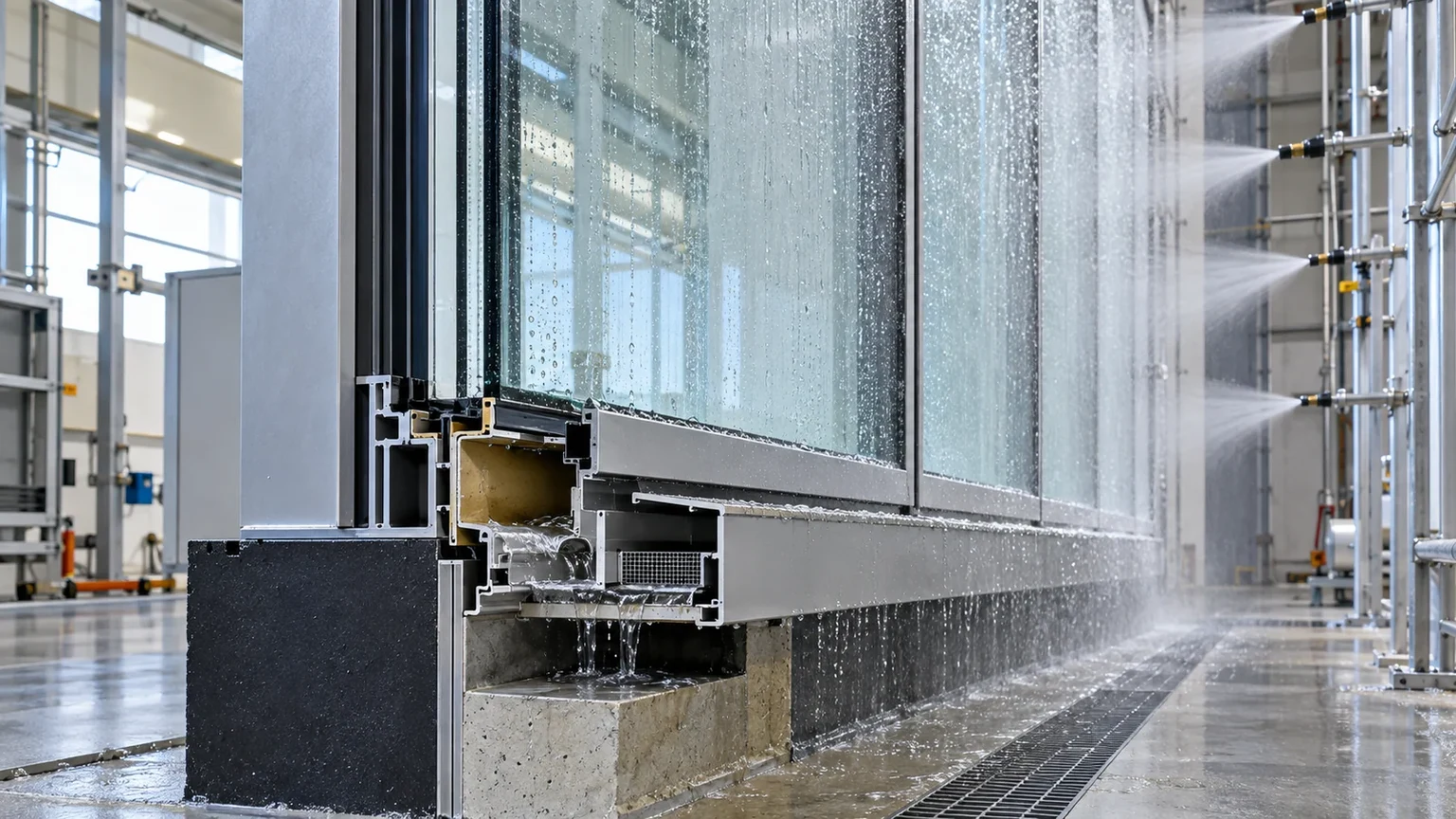
That is why certified casement window air tightness reaches the CW commercial class of 0.06 cfm/ft² at 75 Pa, roughly five times tighter than the 0.3 cfm/ft² permitted in residential classes, and why AW-class casements hold their figure at 20 percent of design pressure in water testing. For buyers the translation is direct: on exposed sites and conditioned buildings, every cubic foot of leakage is conditioned air purchased twice, once at the meter and once at the compressor. The commercial context for these classes sits in our commercial windows guide.
Multi-point locking is an energy device
A single-latch casement compresses its gasket near the handle and relaxes at the corners, which is where leakage and whistle begin. Espagnolette hardware driving three to five locking points keeps compression uniform along the full perimeter, and the same hardware delivers the security rating the insurance file asks for.
On sashes above roughly 1.5 m², multi-point locking stops being optional: the sash’s own wind deflection otherwise unzips the weather side. On energy efficient casement windows the lock schedule belongs inside the thermal specification, with the point count stated per sash size and cycle-test evidence on file, because a commercial sash may see 20,000 operations across its first decade.
Glazing and spacer do the lifting after the frame
Once the frame is broken, glass choice drives the remaining U-value: a 5 + 18A + 5 Low-E argon unit lands near 1.8 W/(m²·K) at centre of glass, while a triple Low-E argon build reaches about 1.1. The spacer decides how much of that survives at the edge, where a warm-edge bar raises edge temperature by 4 to 6 °C and pushes condensation onset well below design interior humidity. Acoustic targets ride the same decision, since laminated build-ups that stop traffic noise also stiffen the energy case. For energy efficient casement windows, five numbers form the comparison set worth demanding per configuration: U-factor, SHGC, air leakage, visible transmittance and condensation resistance.
Casement windows energy code compliance, without the alphabet soup
Energy codes express windows as two numbers by climate zone: a maximum U-factor and a maximum SHGC. Under IECC and ASHRAE 90.1 prescriptive tables, a mid-zone commercial window typically faces a U ceiling near 0.40 to 0.46 Btu/(h·ft²·°F), about 2.3 to 2.6 W/(m²·K), tightening toward 0.32 in cold zones; ENERGY STAR criteria sit in that band as a voluntary benchmark. Casement windows energy code compliance is therefore won or lost on the whole-window figure: compliant glass in a non-compliant frame fails, and the certification must name the actual configuration supplied. Our certifications guide maps which documents authorities and consultants actually ask to see.
A ridge-top study: Hillcrest Residence, Auckland
A study on record describes Hillcrest Residence, a 640 m² two-storey house on an exposed Auckland ridge, where the living level reads as glass from the garden and the bedroom floor sits in a bronze-toned stick-system frame. The exposed coastal site pushed the engineering past code minimum: laminated outer panes, warm-edge spacers and a wind-load specification above the local requirement, proven with a 15 percent margin at mock-up test. The client’s own crew installed the envelope in nine working days, with zero glass breakages in transit. The lesson transfers directly to energy efficient casement windows on exposed commercial sites: specify above the minimum, prove it at mock-up, and let the weather arrive to a finished argument. Fixing methods for exactly this exposure class are covered in our coastal structural glazing guide.
The commercial casement windows specification, line by line
A commercial casement windows specification names performance class and design pressure, whole-window U-factor and SHGC with the rating method, air-leakage class, water resistance, glass build-up and spacer, lock point count per sash size, hinge and stay ratings, finish system and warranty. That completeness is what makes energy efficient casement windows comparable across bidders. A study on record from the Gold Coast shows the payoff at house scale: Ridgeway House, a 365 m² two-storey build, ran one dominant panel type plus corner specials, every bracket pull-out tested to the region’s cyclone classification, and a two-person crew hung the envelope in eight working days on a 13-week programme. Repetition plus a complete specification scales from a villa to a tower, and the developer’s rate version sits in apartment facades on a developer budget.
Send the climate file with the elevations
Send the elevations, the opening schedule, the energy-code target or climate zone the permit names, and the exposure conditions. Ask back for whole-window NFRC 100 U-factor, NFRC 400 air-leakage figures and SHGC per configuration, plus lock point counts and hardware grades per sash size. Starveil Facade returns energy efficient casement windows proposals against exactly that list, engineered and priced from the Foshan plant.
What to carry forward
- Energy efficient casement windows win on geometry: compression seals tighten under wind load.
- Multi-point locking is an energy component, not a security extra.
- Whole-window U-factor and air-leakage class are the only comparable numbers.
- Code compliance belongs to the configuration, not the catalogue.
- Exposed sites deserve above-minimum specifications proven at mock-up.
RELATED READING
Selecting energy efficient casement windows requires more than choosing high-performance glass. Frame construction, thermal breaks, glazing configurations and verified performance ratings must work together as a complete system. Explore our Curtain Wall & Facade Systems hub to understand the range of aluminium window and facade solutions available for different building applications. For a closer look at thermal efficiency, read our guide to Thermally Broken Aluminum Windows, which explains how polyamide strips, frame design and glazing affect whole-window U-values. Our guide to Certifications That Matter: CE / ASTM / Local Approvals explains how to evaluate performance reports and compliance documentation, while Thermal Performance for Facades in Hot-Desert Climates explores the role of solar-control glass, thermal breaks and external shading in reducing building energy loads. Visit Starveil Facade to explore our aluminium window engineering and manufacturing capabilities.
Frequently asked questions
Are energy efficient casement windows tighter than sliding windows?
Yes, by mechanism. On energy efficient casement windows the compression gasket is pressed by wind load and cammed by the locking hardware, reaching the 0.06 cfm/ft² commercial air class; a slider’s brush track typically rates three to five times leakier at equal price. For conditioned buildings on exposed sites, that difference is an energy line item, not a detail.
What U-factor can energy efficient casement windows reach?
With a 24 to 34 mm thermal-break frame, Low-E argon double glazing and a warm-edge spacer, 1.6 to 2.2 W/(m²·K) whole-window is realistic; triple glazing pushes toward 1.2 to 1.4. Demand the figure per configuration under NFRC 100, because glass-only numbers flatter the product.
How many locking points does a commercial casement need?
Scale with sash size: two to three points below 1 m², three to five above. The Hillcrest Residence study on an exposed Auckland ridge pushed every line further: laminated outer panes, warm-edge spacers and a wind-load specification above code, verified with a 15 percent margin at mock-up, then installed by the client’s own crew in nine working days. Lock count belongs on the same schedule line as wind class.
Do casement windows meet commercial energy codes?
Yes, provided the whole-window certified U-factor and SHGC of the energy efficient casement windows meet the prescriptive limits for the project’s climate zone. The certificate must describe the supplied configuration: frame series, break width, spacer and glass. A compliant centre-of-glass number in an unbroken frame does not comply.
Can casements work in cyclone or hurricane zones?
They can, with laminated or impact-rated glass, reinforced hinges and stays, and hardware tested for the zone. The anchoring side matters as much as the sash: on the Ridgeway House study, every cassette bracket was pull-out tested to the region’s cyclone wind classification.
What maintenance do high-performance casements need?
Annual gasket inspection, hinge lubrication and lock-keeper adjustment cover most of it, with coastal sites adding a salt-rinse regime for hardware. Write the intervals into the handover manual; on energy efficient casement windows, seals neglected for five years turn a 0.06 air class into an unmeasured one.
About the author