Three levels, three owners, three reports. Skip one and you inherit its risk
Curtain wall testing runs on a ladder. Level one is paperwork: material and product certificates that prove what was made is what was specified. Level two is the laboratory: air, water and structural tests on a representative assembly under ASTM E283, E331 and E330. Level three is the field: spray-rack checks on installed units, most commonly the AAMA 501.2 water test. Each level belongs to a different party at a different point in the programme, and each produces a report that either clears the next payment milestone or stops the line.
Curtain wall testing is the organised verification of a wall system’s air tightness, water penetration resistance, structural capacity and durability through documented methods at three levels: material certification, laboratory performance testing of representative assemblies, and field testing of installed work. The core curtain wall testing standards are maintained by ASTM at astm.org, covering the laboratory methods, and by AAMA at fgiaonline.org, covering the 501 family of field and mock-up procedures. A test without a named method and a written report is an opinion, whatever the spray rack looked like on the day.
Who runs it, when it runs, what it proves
| Level | Who runs it | When | Methods | Report must name |
|---|---|---|---|---|
| Material and product | Mill, coater, sealant maker | Before fabrication, per batch | GB/T 5237, AAMA 2604, EN 12150, batch records | Batch number, standard, lot date |
| Laboratory assembly | Independent lab with the fabricator | Before production release | ASTM E283 air, E331 water, E330 structural, AAMA 501.1, 501.3, 501.5 | Specimen ID, pressures, pass criteria, deviations |
| Field installed | Installer with witnessing consultant | During installation, on agreed units | AAMA 501.2 water nozzle, E783 field air check | Unit numbers, test pressure, duration, result |
Read the table as a chain of custody: each level of curtain wall testing only means something if the level below it held. Laboratory numbers on non-certified materials are provisional, and field passes on units that left an untested production line are luck with paperwork.
Level one: the certificates that arrive before the wall does
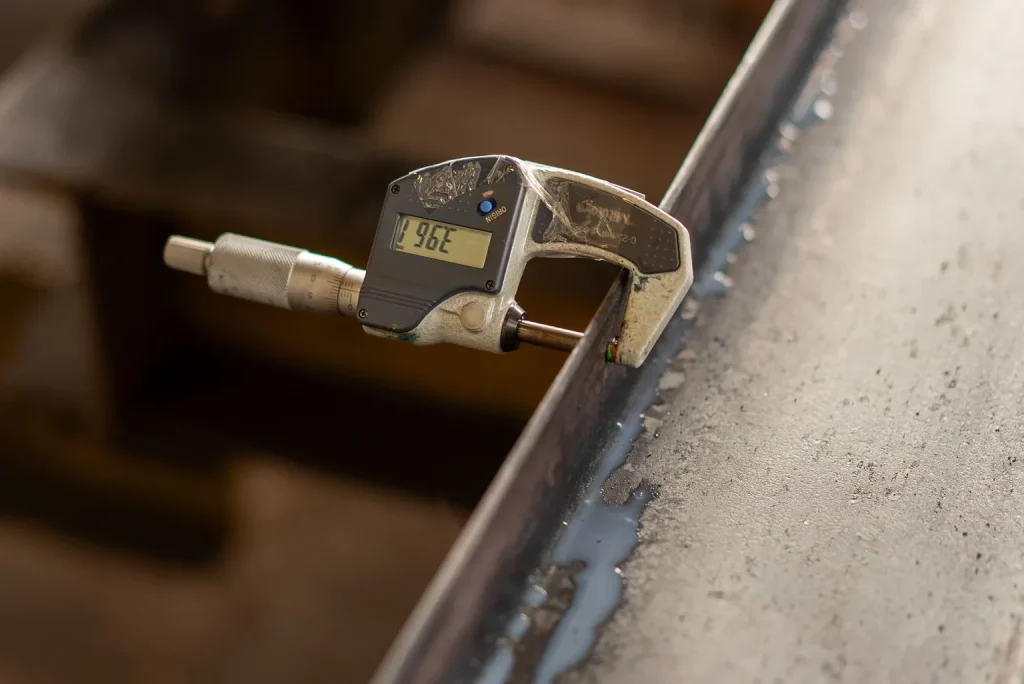
Material verification is the cheapest level and the most frequently fumbled. Mill certificates for the aluminium alloy and temper, coating certificates against the specified finish class, glass processing records for heat treatment and laminating, and sealant batch numbers with shelf-life documentation together form the floor under every later test. The fabricator’s role is traceability: production units numbered against the batches that made them, so a failure found in the laboratory or the field can be traced to its material in hours rather than arguments. Our guide to the certifications that matter lists which documents a buyer should insist on per material, and the fabrication tolerances guide covers the dimensional chain that the same traceability protects.
Level two: the laboratory and its three core methods
Laboratory curtain wall testing takes a representative assembly, worst corner included, and the three methods every buyer should recognise are simple in principle. The curtain wall air leakage test under ASTM E283 measures the air passing through the assembly at a fixed pressure differential, reported as a flow per unit area; the water penetration test under ASTM E331 sprays the specimen at a specified pressure, commonly 720 Pa on demanding projects, with no uncontrolled water past the inner face as the pass line;
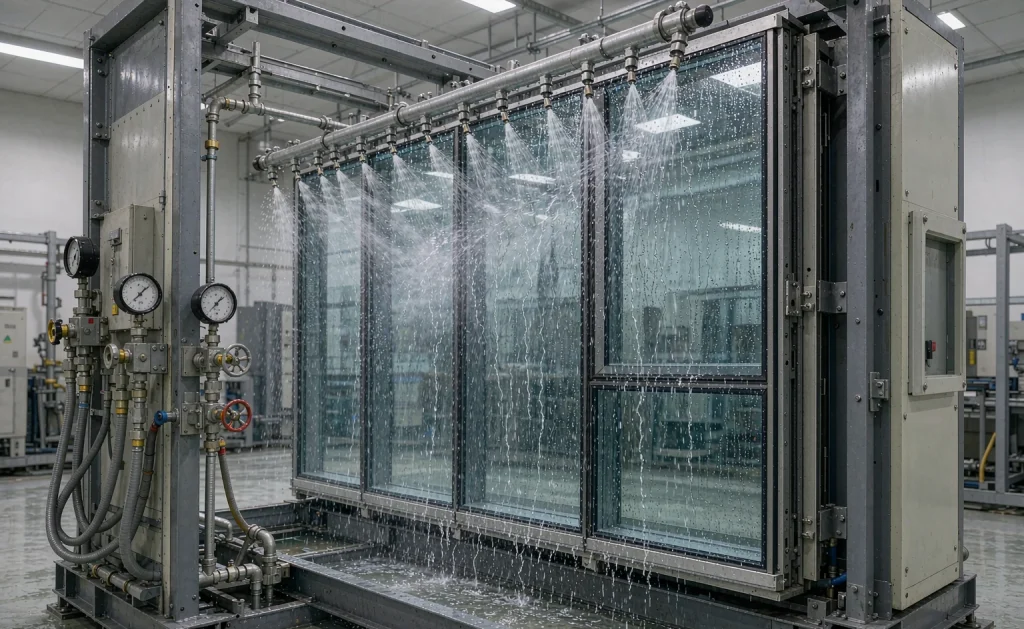
the structural test under ASTM E330 loads the assembly to a proof pressure above design wind and measures deflection against the stated limit, often L/175 or 20 mm. AAMA 501.1 adds dynamic water testing with a moving aircraft-style fan, 501.3 gives the static water alternative, and 501.5 cycles the specimen thermally for sealant and gasket durability. Failures here cost weeks; failures at handover cost years.
Reading the report: five lines that decide everything
A laboratory report is only as good as five specific lines: the specimen identification that ties it to the project grid, the test pressures actually applied, the pass criteria quoted from the specification rather than the laboratory’s default, the deviations recorded, and the signature of the witnessing party. Any of those five missing, and the report proves a wall, but not necessarily this wall. Curtain wall testing disputes in arbitration almost always turn on the first and fourth lines, because a specimen built from different profiles or a deviation quietly accepted on the day can hollow out a pass certificate. Buyers who cannot attend should nominate the witnessing consultant by name in the contract, which costs a fee and buys the only thing that makes paper enforceable: a person who was there.
Level three: the field, the nozzle and the installer’s crew
Field curtain wall testing answers a different question from the laboratory: not whether the system can work, but whether this crew installed it that way. The aama 501 field water test in its 501.2 form is a calibrated nozzle, a stated pressure and a timed sequence applied to selected installed units, typically one per elevation per number of floors agreed in the specification, with water on the face and an observer inside. ASTM E783 gives the field counterpart for air leakage where the contract asks for it. Failures are repaired and retested, and the retest is part of the record, not a footnote to it. The installation standards guide covers the holding patterns around field tests, and the mock-up guide covers the specimen that should already have caught whatever the nozzle finds.
What a delivered arena shows about the ladder in practice
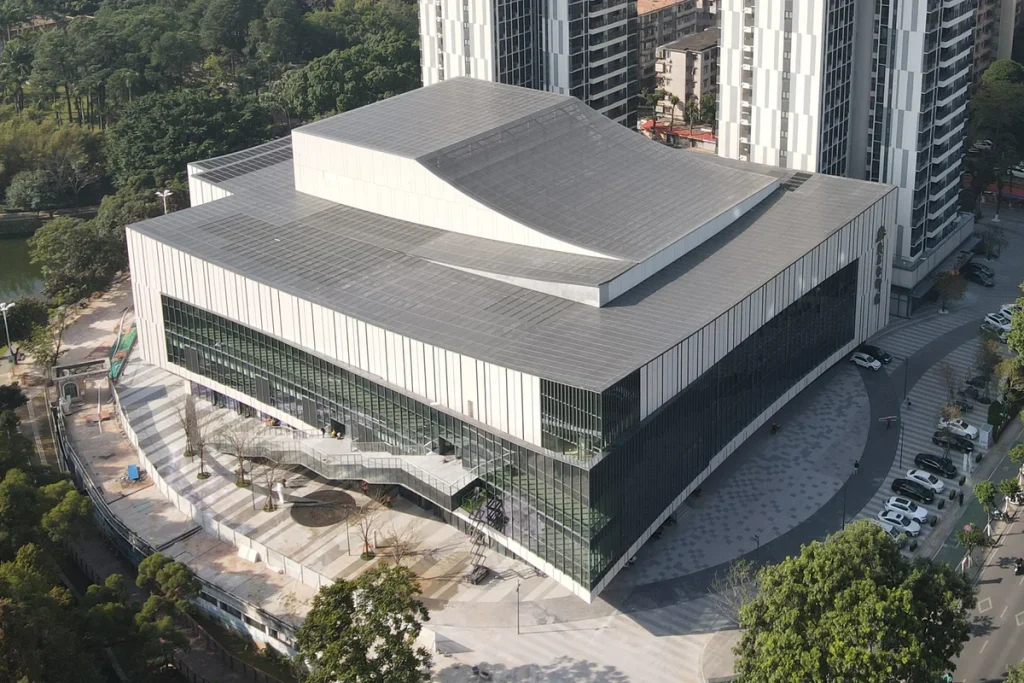
The Botswana sports arena in Gaborone, a delivered 5,200 m² envelope of curved glazed concourse and folded aluminium volumes around an 8,000-seat venue, ran the ladder under real programme pressure: 28 weeks ex-works, flat-packed in container sequence, erected by the local main contractor with our supervising engineer on site for critical setting-out, first-panel approval and final sealant audits.
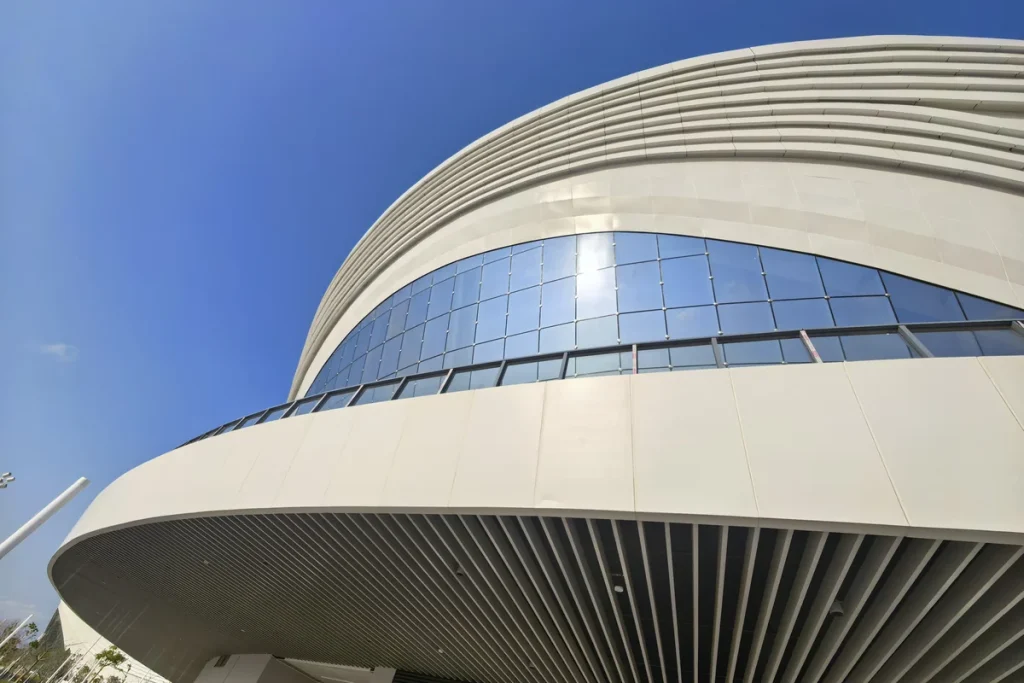
Six mm monolithic glass was chosen for the concourse band because the climate and the brief allowed it, which is itself a testing decision: the performance testing was scoped to what the specification actually demanded rather than to a generic tier. Every panel is replaceable from outside, and the panel-by-panel manual handed to the maintenance team extends the test record into the operating life of the building.
Who pays for which level, and when each one earns out
The cost logic is asymmetric. Level one is paperwork discipline and costs attention, not money. Level two costs a specimen, a laboratory and a schedule slot, and it earns out on any envelope with custom details, high exposure or repeating grids, which is most of them. Level three costs a hose, a morning and a decision about which units to hit, and it is the only level that tests the crew rather than the product. Curtain wall testing budgets should be written as three lines in the contract, one per level, with the witnessing party named for each. Starveil Facade scopes all three from the Foshan engineering desk before production release, because retrofitting a test programme after fabrication is buying the same knowledge at the site premium.
Send the spec numbers, ask for the ladder
Send the specification’s air leakage limit, water penetration resistance pressure, design wind pressures by zone, and any thermal or seismic cycling requirements, together with the elevation and the project programme. Ask back for the curtain wall testing plan as a three-level schedule: the certificate list with traceability to unit numbers, the laboratory scope naming E283, E331, E330 and any AAMA 501 variants with specimen identity, and the field test protocol with unit selection and witnessing arrangements. A supplier who answers that question in schedule form has run the ladder before.
What to carry forward
- Three levels, three owners: mill, laboratory, installer, each with a named report.
- Curtain wall testing standards only bite when the report names specimen, pressure and criteria.
- The laboratory proves the system; the field test proves the crew.
- Field failures are part of the record: repair, retest, file.
- Traceability from unit number to batch is what makes every level of curtain wall testing enforceable.
Frequently asked questions
What does a curtain wall testing programme include?
Three levels: material and product certificates before fabrication, laboratory performance testing of a representative assembly before production release, and field testing of installed units during construction. Each level has its own methods, owner and report, and the contract should name all three.
What is the curtain wall air leakage test, and where does it sit inside a curtain wall testing programme?
Under ASTM E283 the curtain wall air leakage test measures airflow through a laboratory specimen at a fixed pressure differential, commonly reported in cubic metres per hour per square metre. Demanding specifications hold leakage near 0.3 m³/(h·m²) at 75 Pa or the equivalent 0.06 cfm/ft² class; the number to enforce is the one written in your energy code, with the method named beside it. It is the second step in the three-level curtain wall testing programme, sitting between material certification and the field water test on the installed units.
How is the AAMA 501 field water test performed?
As AAMA 501.2, with a calibrated nozzle delivering water at a stated pressure for a timed sequence over selected installed units, while an observer checks for uncontrolled penetration inside. It is a go or no-go check of workmanship on the real crew, not a substitute for laboratory testing of the system.
Can field testing replace the laboratory mock-up?
No. The laboratory proves the design and the field proves the installation; they answer different questions with different methods. What the field test can do is catch workmanship defects early, which is exactly what happened on the delivered 5,200 m² Botswana arena envelope, where first-panel approval and final sealant audits anchored the installation record alongside the factory evidence package.
Does every project need the full AAMA 501 family?
No. AAMA 501.1 dynamic water, 501.3 static water and 501.5 thermal cycling are scoped to the exposure and the system: high-wind sites, deep seals and climate extremes pull more variants into the curtain wall testing programme. The specification should pick the variants by risk, not by brochure thickness.
Who witnesses the tests and why does it matter?
The owner’s consultant or an independent inspector, named in the contract. Curtain wall testing reports without a named witness are the ones that dissolve in disputes, because the counterparty can argue the specimen or the sequence differed from the approved plan. A person in the room is the cheapest insurance on the report.
RELATED READING
For a broader understanding of curtain wall performance and quality control, explore our curtain wall system guide, which explains how framing, glazing, seals and other components work together as a tested assembly. For project documentation and compliance, read our guide to facade certifications and testing requirements. Before production begins, our facade mock-up testing guide explains how to verify representative specimens and identify performance problems early. For the final stage, see our curtain wall installation standards guide to understand field inspections, water testing and installation acceptance.
About the author