Four frequencies, four depths of looking
| Frequency | Scope | Typical method | What it catches |
|---|---|---|---|
| Quarterly | Visual walk of elevations from ground and upper levels | Binoculars, phone camera, checklist | Cracked sealant, blocked weeps, loose fittings, glass damage |
| Annual | Close inspection of a sample of joints per elevation | Rope access or BMU, written report with photographs | Gasket compression set, sealant adhesion loss, hardware wear |
| After storms | Windward elevations and roof interfaces | Targeted visual check within days of the event | Displaced caps, split seals, drainage overwhelm |
| Five-year | Sample joints opened, sealant and gaskets laboratory-checked | Scaffold or BMU at sample locations, lab adhesion tests | Hidden adhesion loss, section corrosion, system-level trends |
This table is the spine of a curtain wall maintenance programme, and the spine of the curtain wall inspection schedule that goes into the building’s operations file. Frequencies flex with exposure: coastal and dusty sites shorten every interval by roughly half. Who pays for each rung is a different question, answered in our curtain wall warranty guide.
What actually fails first, and in what order
Twenty years of envelopes fail in a predictable sequence. Exterior sealant joints show cracking or adhesion loss first, within 10 to 15 years of installation and earlier on sun-blasted elevations. Weep holes block next, quietly, with dust and insect debris, and a blocked weep turns a drained joint into a full bath at every storm. EPDM gaskets take compression set over 10 to 15 years, losing the seal they were bought for; hardware follows, with corrosion on non-marine grades and wear on operable sash cycles. Glass itself rarely initiates a failure. A curtain wall maintenance programme that watches seals and drainage is watching the right things.
The gasket clock, and why it runs whether or not anyone reads it
The facade gasket replacement cycle is a planning number, not a theory: elastomeric gaskets age from day one, and by years 10 to 15 compression set and surface crazing have usually taken them past their design seal. Replacing gaskets is labour-priced, not material-priced; the rubber is a small share of the invoice, the access is the rest, which is why gasket work is batched with rope access visits that are already scheduled. Order gaskets against the original section drawings, because profile gaskets are profile-specific, and a “close enough” substitute leaks on principle. The second life of seals, panels and parts is covered in our replacement panels years later guide.
What maintenance costs, in the orders of magnitude that matter
Numbers vary by market, but the ratios hold. Quarterly visual walks are a rounding error, in-house staff with a checklist. Annual close inspections run a few dollars per square metre of facade, dominated by access. Storm-response checks are targeted and cheap when done within days. The five-year survey with sample joints opened costs real money, and the sealant renewal programme it usually triggers, priced per linear metre of joint, is the largest single line in a decade of curtain wall maintenance. All of it together typically runs a fraction of one percent of envelope replacement cost per year, which is the argument in one sentence. For the wider budget picture, our facade cost guide sets maintenance in the total cost of ownership.
A theatre that was handed a manual along with its facade
Public buildings show why the paperwork matters. The delivered Maoming City Theatre, a 4 600 m² curved glass and stone envelope over a 1 200-seat auditorium, was completed as a single design-supply-installation engagement on a 26-week ex-works programme, and it closed with a documented panel-by-panel manual that gives the municipal maintenance team a single reference for every future inspection and replacement.
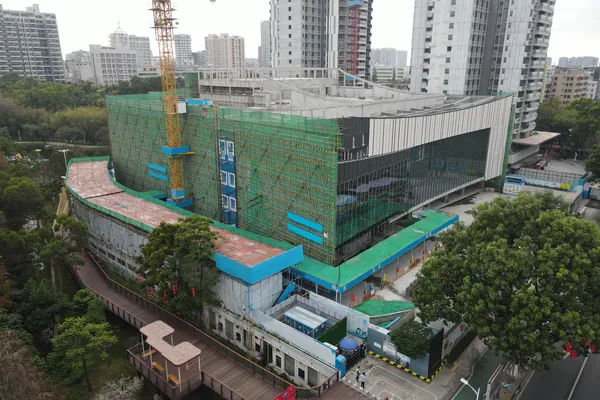
On a civic envelope with curved glass, a curved panel cannot be re-ordered from a catalogue: it is remade from the record. That manual is curtain wall maintenance converted from a chore into a lookup, and it is why we issue maintenance documentation as a deliverable, not a courtesy.
Cleaning: the maintenance task that causes the most damage
More facades are damaged by cleaning than by weather. Unapproved chemicals dull PVDF gloss and etch glass coatings; high-pressure washing drives water past weeps into drained cavities; untrained rope crews crack caps and sills underfoot. The cleaning section of a curtain wall maintenance checklist should name the approved detergents, forbid pressure washing above a stated limit, and require the same access plan as an inspection. Buildings in dusty climates, like our Gulf projects, should also schedule seal-friendly rinsing, because grit left in joints becomes an abrasive every time the joint moves.
Trading through it: maintenance on occupied buildings
Most curtain wall maintenance happens while the building stays open, and the constraint is not technical but operational: tenants, shoppers and the public keep moving underneath the work. Phased programmes, night work on retail frontages and sealed walkways are the standard answers, and the sequencing logic is the same one our phased facade works guide sets out for larger interventions. When maintenance escalates into component renewal, the same phasing turns a disruptive project into a schedule. Envelopes that reach that stage move onto the renovation track covered by our أنظمة تجديد الواجهات.
Send the building, ask back for the programme
Send the facade area, the access equipment available, the exposure environment, and the age of the envelope if it is not ours. Ask back for a curtain wall maintenance programme written against the actual system: an inspection ladder with frequencies, a gasket and sealant renewal forecast in years, a cleaning specification with approved chemicals, and the spare parts list worth holding on site. Starveil Facade writes those programmes from the Foshan engineering desk, from the same drawings the envelope was fabricated to.
What to carry forward
- Curtain wall maintenance is a sealing and drainage discipline: seals, weeps, gaskets and hardware fail long before glass.
- Quarterly looks, annual reports, storm checks and a five-year sample survey form the ladder that catches failures early.
- Plan gasket and sealant renewal for years 10 to 15, and batch it with access that is already scheduled.
- Approved cleaning chemistry is part of the specification; unapproved cleaning is how facades get damaged.
- Log every visit; maintenance records are what keep warranties callable.
RELATED READING
For a broader understanding of facade performance, maintenance and long-term planning, explore our Facade Insights Hub, where we cover practical engineering considerations for building envelopes. You may also find our guides on curtain wall waterproofing and drainage strategies, facade durability in coastal and dusty environments, and facade costs and long-term budget planning useful when planning inspections, component replacement and future maintenance budgets. To learn more about our facade engineering capabilities and complete building envelope solutions, visit Starveil Facade.
Frequently Asked Questions
What belongs on a curtain wall maintenance checklist?
Per elevation: sealant joints read for cracks and adhesion, gaskets read for compression set, weep holes checked for blockage, hardware cycled and lubricated, glass scanned for impact damage and edge defects, and finishes read for chalk, fade or corrosion spotting. The checklist should name the locations inspected and carry photographs, so the next visit compares against something.
How often should curtain wall inspection happen?
Quarterly visual walks, one annual close inspection with a written report, storm-response checks within days of major events, and a five-year survey that opens sample joints. Coastal, dusty or high-traffic sites should halve the intervals, and the curtain wall inspection schedule should name who does each rung and where the reports live.
How long do facade gaskets last?
EPDM gaskets on a typical envelope last 10 to 15 years before compression set and crazing take them past their design seal, which is why the facade gasket replacement cycle belongs in the operations budget as a planned item, not an emergency one. Access is the dominant cost, so gasket renewal should ride on inspection visits already in the calendar.
Can curtain wall maintenance be skipped on a new building?
The first two or three years can run on quarterly walks alone, and new-build defects tend to surface in that window. From year five the five-year survey starts earning its fee, and from year ten the sealant and gasket forecast starts spending it. Skipping the curtain wall maintenance programme does not delay the clock; it removes the chance to see the alarm before it goes off.
Does curtain wall maintenance affect the warranty?
Usually yes, in writing. Most facade warranties make cover conditional on the documented maintenance intervals in the handover manual, and skipped inspections are a standard exclusion when a seal fails. The five-line structure of warranty terms, triggers and exclusions is covered in our curtain wall warranty guide, and the maintenance log is the document that keeps each line callable.
What does a maintenance programme cost per year?
As orders of magnitude: quarterly walks in-house, an annual inspection at a few dollars per square metre of facade, and a five-year survey that costs real money once and usually saves more. Together these run a fraction of one percent of envelope replacement cost annually. On the delivered Maoming City Theatre, the 4 600 m² envelope closed with a panel-by-panel maintenance manual, so the municipal team budgets for inspection labour rather than archaeology before every repair.
عن الكاتب