One question decides it: is this member a beam or a bracket?
| Property | 6061-T6 | 6063-T5 (architectural) | What it decides |
|---|---|---|---|
| Yield strength (typical) | ~240 MPa | ~160 MPa | Bracket and plate sizing vs mullion spans |
| Ultimate tensile (typical) | ~290 to 310 MPa | ~200 to 230 MPa | Member capacity under point loads |
| Extrudability | Moderate; thin complex sections cost more | NExcellent; fine, repeatable surface | Visible profile finish and die cost |
| Weldability | Good; welded joints keep useful strength | Weldable, but joints lose strength; usually mechanically fixed | Shop-welded assemblies vs screwed joints |
| Finish response | Tone varies; anodizing less uniform | Takes anodizing and PVDF evenly | Colour consistency across elevations |
| Cost | Higher per tonne; slower press output | Lower; high press throughput | Envelope budget and lead time |
Read 6061 vs 6063 as a load-path question. A mullion is a bending problem that is also a finish surface, so 6063 wins there; a bracket is a point-load problem, so 6061 wins there. Die economics follow the same split: complex 6063 sections run through dies commissioned with our long-term partner die makers, and the tooling logic is mapped in our aluminium extrusion dies guide.
Brackets, plates and point loads: where 6061 pays for itself
Every envelope hides a family of small parts that carry concentrated forces: anchor plates bolted to slab edges, fin plates carrying operable sashes, splice plates at stack joints, cleats under heavy sliding-door tracks. The 6061 vs 6063 split starts here, at the concentrated forces. These members are sized by bearing and bolt capacity, and they are often welded in a fixture before they reach site. That is the natural territory of 6061-T6, whose roughly 240 MPa yield lets a plate stay thinner under the same load. Swapping these parts to 6063 usually means adding 30 to 50 percent more metal, so the saving evaporates in weight and machining.
Mullions and visible trims: the case for 6063
The aluminum grade for curtain wall mullions is decided less by strength tables than by finish and section economics. A mullion is sized by span and wind load, and its capacity comes from section depth rather than alloy headroom, which is why our curtain wall mullion guide treats grade as a finish and cost decision once the structural check passes. 6063 extrudes fast, holds tight tolerances on thin walls and takes anodized and PVDF finishes with even colour across a whole elevation. On the wind side, envelopes exposed to typhoon-class loading, as covered in our typhoon-rated glass walls guide, are usually resolved with deeper 6063 sections rather than a move to 6061.
Temper is half of the answer: 6061 t6 vs 6063 t5
In the 6061 vs 6063 decision, temper is half the answer. T5 means the profile was air-cooled from the press and artificially aged; T6 means it was solution heat-treated first, buying extra strength at extra cost. The practical comparison buyers face is 6061 t6 vs 6063 t5, because those are the conditions the architectural market actually quotes: about 240 MPa yield against about 160 MPa. When a mullion calculation comes up short, the upgrade path is usually 6063-T6 at around 185 to 215 MPa yield before anyone reaches for 6061, because the finish and die investment already sit on the 6063 line. Ask for the temper in writing, because a quotation that names the alloy but not the temper has not finished speaking.
One villa envelope, two grades working together
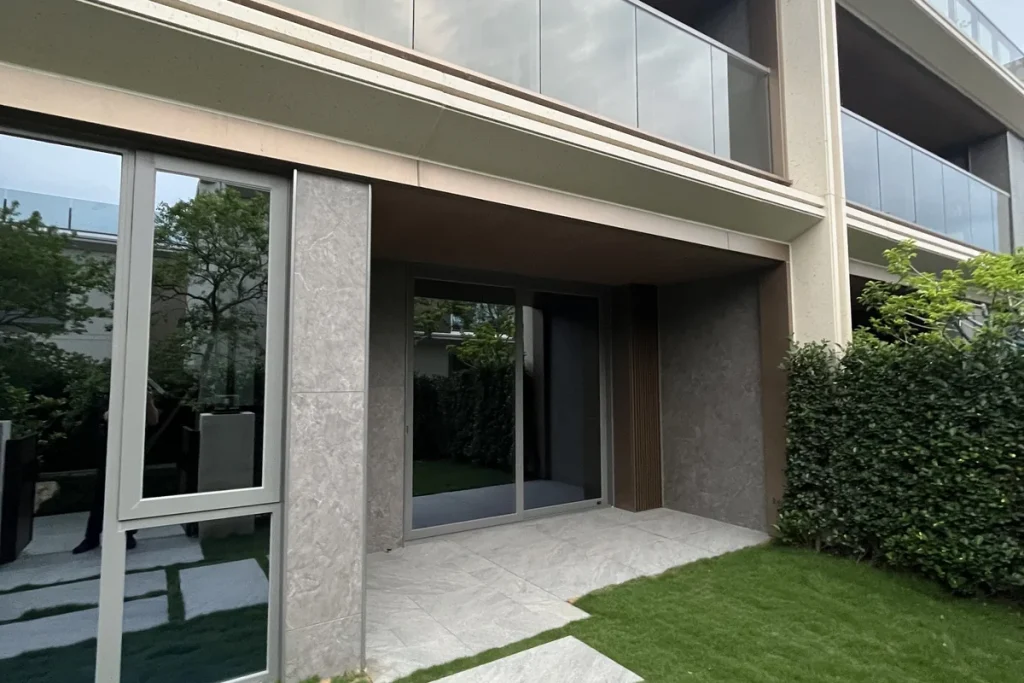
The split shows up clearly on real envelopes. The delivered Foshan premium villa package for China Overseas Land, a 380 m² thermal-break aluminium window and door envelope delivered in 12 weeks ex-works, ran sliding doors in the principal living spaces, casement windows through the bedrooms and frameless glass railings to the terraces.
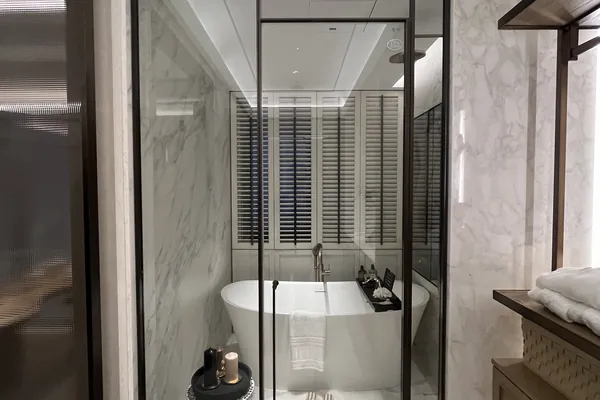
Every visible profile is a finish surface a hand will touch and an eye will read at two metres, which is 6063 territory; the buried load interfaces under the heavy sliding tracks and the anchor connections are point-load work, which is 6061 territory. On that delivered envelope the 6061 vs 6063 decision was made profile by profile, not envelope by envelope. How those finished surfaces are then coated, and what a coating class is worth in different climates, is covered in our PVDF coating guide.
Wind, span and the depth trick that beats a grade change
When a wind-load check fails, the instinct is to change alloy. The cheaper move is almost always depth. Bending capacity in a mullion grows with the square of depth in the strong axis, so moving a 6063 section from 120 mm to 150 mm deep buys far more capacity per dollar than switching to 6061, and it keeps the finish, the die and the press schedule unchanged. Our unitized curtain wall system works this way: higher wind zones get deeper 6063 mullion sections, while 6061 stays in the bracket family behind the panel. In practice this is where 6061 vs 6063 gets settled: grade changes belong at point loads, section changes belong in bending.
What 6061 vs 6063 looks like on paper: certificates and claims
A grade promise without paperwork is a promise to no one. The schedule of materials should name alloy and temper for every profile line, and each production batch should travel with mill certificates testifying to chemistry and mechanical properties against a named standard such as ASTM B221 or GB/T 5237.1. Search results for 6061 vs. 6063 rarely mention the failure that actually happens: a supplier quoting a 6063 price while delivering unmarked alloy, which surfaces years later as a finish mismatch or a bent bracket. Coastal projects should add the durability lens, because finish class and alloy together decide how an envelope ages; our salt and sand facade durability guide covers that environment in detail.
Send the loads, ask for the schedule of materials
Send the wind pressure, the floor-to-floor spans, the operable sash weights and the exposure class. Ask back for a schedule of materials that lists every profile with its alloy and temper, the wind-load summary for the governing zone, and the certificate scheme for production batches. The 6061 vs 6063 decision should live on that schedule, line by line, before any deposit moves. Starveil Facade issues the schedule of materials with every quotation from its Foshan engineering desk.
What to carry forward
- 6061 vs 6063 is a load-path decision: 6061-T6 for brackets, plates and welds; 6063-T5 for mullions, pressings and trims.
- Temper is half the answer; a grade named without a temper is an unfinished specification.
- In bending members, added depth usually beats a higher grade on cost.
- Mill certificates name alloy, temper and standard, or they name nothing.
- Budget die cost early with your supplier’s partner die makers; complex 6063 sections are where tooling earns back.
RELATED READING
Choosing between 6061 and 6063 aluminum alloys depends on structural loads, profile design and finish requirements. Explore our aluminum windows and facade solutions for project-specific applications. For more technical insights, read our guides to aluminium extrusion dies, insulated curtain wall systems, and facade fabrication tolerances.
Frequently asked questions
How does 6061 vs 6063 affect curtain wall mullion selection?
It affects it less than most buyers expect. Once the bending check passes, the mullion decision is about finish, colour consistency and press economics, which all favour 6063-T5. 6061 enters a mullion line only where concentrated loads land, such as a heavy operable sash hung off a single section, and it appears as local reinforcement rather than a full grid change.
Which is stronger in a 6061 vs 6063 comparison?
6061-T6 is stronger on the cards, at roughly 240 MPa yield and 290 to 310 MPa ultimate tensile, against about 160 MPa yield for 6063-T5. Strength per kilogram is a different contest, because a deeper 6063 section often matches a 6061 section at lower cost while keeping the better surface, so the comparison that matters is per installed member, not per tonne.
Can 6063 profiles be welded the same way as 6061?
They can be welded, but the heat-affected zone loses a large share of the aged strength, so welded 6063 joints are designed conservatively or avoided. 6061 keeps more useful strength after welding, which is why shop-welded bracket assemblies are 6061 territory while site-jointed 6063 work is bolted or cleated.
What is the aluminum grade for curtain wall mullions in coastal projects?
6063-T5 or 6063-T6 remains the standard answer, paired with a high-durability finish class and proper drainage. Salt exposure attacks finish and hardware long before it attacks the alloy, so specification effort belongs in coating class and gasket materials rather than in a grade change.
Does 6061 cost more than 6063?
Modestly more per tonne, and more in press time, but the 6061 vs 6063 price gap is small next to the cost of a wrong call: re-machined brackets, mismatched finish tones or a re-run of structural checks. The gap that matters is total envelope cost, where each grade used where it belongs beats either price per kilogram.
How do we verify the grade and temper on delivery?
Match the schedule of materials to the mill certificates batch by batch, and sample-check mechanical properties on long runs. On the delivered Foshan villa package, 380 m² of thermal-break aluminium doors and windows shipped on a 12-week ex-works programme with every profile traceable to its certificates, so a grade claim on that envelope is a lookup, not a debate.
About the author